



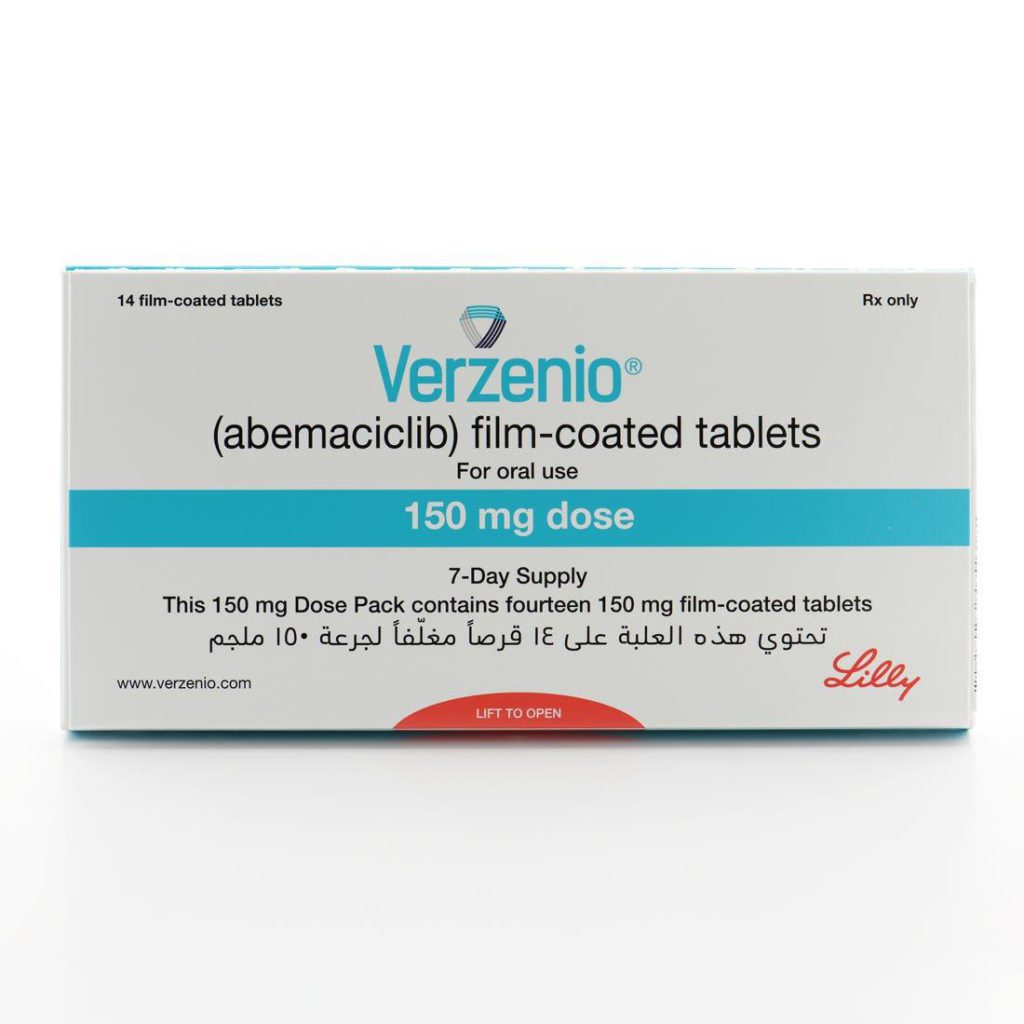
Abemaciclib (Verzenio) — targeted treatment for selected breast cancers
What abemaciclib is in simple patient language
Verzenio — brand name. Abemaciclib — the drug name in medical records. A cancer tablet. A targeted drug. Not chemo. Not immunotherapy.
Why it comes up: some breast tumors still depend on hormone signals, and HER2 is not the main driver. In that setting, the doctor may want stronger control over how tumor cells keep dividing.
Tablet form can sound simple. It is not simple treatment. Stool, blood counts, liver values, infection signs, clot risk, breathing symptoms, and the hormone drug used with it all matter before and during the plan.
How abemaciclib works
Some breast cancer cells keep getting a push to divide because the inner growth signal does not quiet down. CDK4 and CDK6 sit inside that signal.
Abemaciclib lowers that activity. In plain words, it makes it harder for the cell to keep stepping forward into division.
This does not mean one tablet solves the whole problem. Most of the time, Verzenio sits next to hormone treatment. One part works on hormone dependence. The other part adds pressure on cell division.
The doctor does not judge this by one good day or one bad day. Scans, symptoms, labs, bowel tolerance, liver values, and the pace of the disease are read together.
Which diseases abemaciclib may be used for
Abemaciclib is mainly discussed in breast cancer with hormone receptors showing and HER2 not acting as the main target. The setting still has to fit.
- breast cancer that has spread and needs treatment for the whole body
- disease that was controlled by hormone treatment for a time and then became active again
- treatment with an aromatase inhibitor in selected plans
- treatment with fulvestrant after earlier hormone therapy stopped holding the disease
- selected early breast cancer after surgery when the return risk is high
- comparison with another CDK4/6 drug when side effects or the treatment goal matter
Hormone receptors alone do not make the decision. Stage, prior drugs, risk of return, age, bowel history, liver values, clot history, and general strength can change the plan.
When abemaciclib can be especially relevant
It usually enters the discussion when hormone treatment alone may not be enough, or when the doctor wants more control without moving straight to classic chemotherapy.
- the disease is already spread out and needs a systemic plan
- a tumor answered hormone treatment before but started growing again
- the doctor is choosing a plan with fulvestrant or another hormone drug
- after surgery, the risk of the disease returning is not low
- several CDK4/6 options need to be compared
- the patient needs to know whether long daily tablets are realistic
The real question is not whether Verzenio is strong. The question is what job it has in this patient: hold the disease, lower return risk, delay chemotherapy, or keep control with a manageable burden.
What needs to be checked before treatment
One old discharge letter is rarely enough. The doctor needs the tumor picture and the patient picture now.
- tumor type and pathology report
- ER, PR, and HER2 results
- stage and current scans
- what treatment was already given, what worked, and what stopped working
- CBC and blood chemistry
- liver tests and bilirubin
- diarrhea, stomach pain, weakness, appetite, and weight
- clot history, leg swelling, chest symptoms, or vascular risk
- current medicines, including hormone treatment and regular home drugs
- pregnancy or pregnancy plans, when relevant
Diarrhea needs a plan before the first tablets. Not after several bad days. With this drug, loose stool is not a small side note. It can become dehydration, weakness, and a reason to pause treatment.
How treatment with abemaciclib goes
Tablets are taken by the schedule given by the oncologist. No dose changes at home. No planned breaks by guess. No restarting after a pause without asking.
Treatment often runs for months, and sometimes longer. So the doctor watches two things at the same time: is the cancer controlled, and can the patient live on the tablets safely enough.
What usually gets watched:
- daily tolerance of the tablets
- stool frequency and drinking enough fluids
- CBC, especially neutrophils, hemoglobin, and platelets
- liver enzymes and bilirubin
- temperature and infection signs
- cough, breathlessness, or new chest pain
- leg swelling, leg pain, or other clot warning signs
- planned scans for disease trend
A side effect does not always end the treatment. Sometimes the move is a pause, a lower dose, diarrhea support, extra labs, or closer contact for a while. The doctor decides what is safe.
Possible side effects
The pattern is not the same for everyone. One person mainly has bowel trouble. Another has fatigue. Another has low blood counts or liver test changes.
What can happen:
- loose stool or frequent diarrhea
- nausea, stomach pain, poor appetite
- tiredness, low energy, weakness
- neutrophils or other blood cells going down
- liver test changes
- infection risk when blood counts are low
- leg swelling, leg pain, or clot concern
- cough, breathlessness, or lung inflammation signs
- changes in blood tests or chemistry results
Do not wait for a symptom to become dramatic. Early reporting often helps keep the plan from turning into an emergency.
When the treating team needs to know fast
Do not save these symptoms for the next routine visit:
- strong or repeated diarrhea
- dry mouth, poor drinking, dizziness, or marked weakness
- fever, chills, sore throat, or other infection signs
- yellow eyes or skin, dark urine
- new breathlessness, cough, or chest pain
- leg swelling or leg pain, sudden weakness
- unusual bleeding or bruising
- quick decline without a clear reason
Do not try to prove at home whether Verzenio caused it. The treating team should make that call.
Why abemaciclib is not right for everyone
Abemaciclib can be useful in the right breast cancer setting. It is still not a tablet for every patient with breast cancer.
The doctor may choose another path if:
- the tumor does not have the hormone profile needed for this plan
- liver problems are too strong
- diarrhea or bowel disease is already a major issue
- clot risk is high
- blood counts are too low before treatment
- there is active infection or very weak general condition
- another option fits the goal better right now
Choosing something else does not mean Verzenio is a bad drug. It may simply be the wrong tool for this body, this tumor, or this moment.
Can abemaciclib be combined with other treatments
Yes. Most often, the discussion is not about Verzenio alone. It is about Verzenio with hormone treatment. The combination still needs a clear reason.
- with an aromatase inhibitor in selected plans
- with fulvestrant after earlier hormone therapy
- after surgery when return risk is high
- with medicines for diarrhea, nausea, or other symptoms
- after local treatment of selected spots when that belongs to the wider plan
More drugs do not automatically mean a better plan. Each part needs a job, and the patient needs to know what will be watched.
What no quick response can mean
A fast answer is not always visible. The patient may already be taking tablets while the scans still cannot give the final picture.
Sometimes tumor spots shrink. Sometimes the useful result is quieter disease: no fast growth, symptoms calmer, labs still allowing treatment. In advanced disease, that can matter.
The doctor does not read one number alone. Scans, symptoms, labs, side effects, and the old speed of the disease need to be put together.
Oncology consultation in Israel about abemaciclib
At Tel Aviv Medical Clinic, a patient with breast cancer can discuss whether abemaciclib has a place in the current plan. This can help when Verzenio was offered, but the reason, risks, or alternatives are not clear.
A consultation may help to:
- review ER, PR, and HER2 results
- understand why this CDK4/6 drug is being discussed now
- compare Verzenio with other CDK4/6 options
- look at diarrhea, blood count, liver, clot, and lung risks
- get a second opinion on adjuvant or metastatic treatment
- prepare questions for the treating oncologist
- discuss which options may be relevant in Israel
We do not prescribe remotely and do not replace the treating physician. We help the patient and family understand the medical logic and prepare for the next step.
Frequently asked questions — answered by Dr. Stefanska
- So, is Verzenio chemotherapy?
No. I would not put Verzenio in the chemo box. It works through CDK4/6, a switch that some breast cancer cells use to keep moving into division.
Still, it is not a harmless pill. The form is simple; the treatment is not. I want to know about stool, drinking, fever, blood counts, liver numbers, leg swelling, chest symptoms, and the patient’s real strength at home.
- Why is it often paired with hormone treatment?
Because this breast cancer type often has more than one road feeding it. The hormone road is one. The cell-cycle road is another. Hormone treatment works on one side. Verzenio tries to slow the other.
I would not choose the pair from the name alone. I need the receptor report, the old treatment story, how long control lasted, why it stopped, and what the patient can manage every day. For one patient it is a good plan. For another, too heavy.
- What if diarrhea starts?
Do not watch it for a week. Loose stool with Verzenio is a warning light. Sometimes small. Sometimes the start of a bigger problem.
The plan should be clear before the first dose: what to drink, which medicine is allowed, when to call, and when tablets may need to wait. It is easier to stop dehydration early than to fix it late.
- If blood tests are worse, does the drug have to stop?
No, not automatically. I first look at which line changed: neutrophils, hemoglobin, platelets, liver numbers. Then I look for fever, infection, bleeding, and how the patient actually feels.
Do not decide from the lab sheet at home. Send the numbers and dates. Sometimes nothing changes. Sometimes we repeat labs. Sometimes we pause or lower the dose. That call needs the full picture.
- Why ask about clots and breathing?
Cancer itself can raise clot risk. This treatment makes that point more important. A swollen painful leg, sudden trouble breathing, pain in the chest, or a strange drop in strength should be reported the same day.
It may be Verzenio. It may be the cancer. It may be something else. I do not need the patient to solve that at home. I need to hear about it in time.
- Can it be used after another CDK4/6 drug?
Sometimes yes, sometimes no. This is one of those questions where the name of the tablet is not enough.
I need to know which CDK4/6 drug came first, which hormone drug was used with it, how many months it held, what side effects appeared, and what the new scans show. If the disease moved while the same road was blocked, another similar step may not do much.
- What should I send before a consultation about Verzenio?
Send the papers that tell the story, not only the last note: biopsy, ER, PR, HER2, recent scans, blood tests, liver values, treatment dates, and why each treatment stopped.
Also send a plain timeline. Diagnosis date. What helped. When the cancer moved again. Any diarrhea, clot, infection, liver problem, or regular medicine. These small details often decide whether Verzenio is realistic.
Important information
This page gives general medical information only. It is not a treatment recommendation. Abemaciclib is discussed only after review of the diagnosis, receptor results, scans, prior treatment, blood tests, liver values, side effect risks, and general condition.
Do not start, stop, or change treatment without speaking with the treating physician.
Contacts
For a consultation about abemaciclib:
📞 +972-73-374-6844
📧 [email protected]
💬 WhatsApp: +972-52-337-3108
