



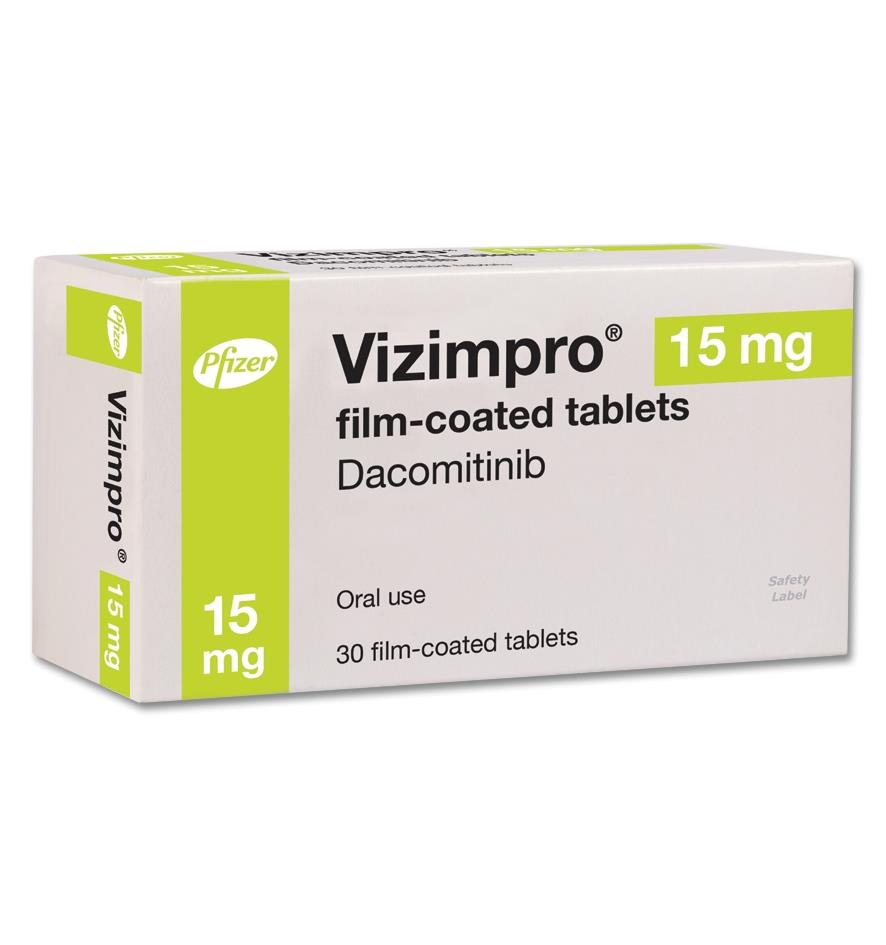
Dacomitinib (Vizimpro) – targeted treatment for EGFR-driven lung cancer
What dacomitinib is in simple patient language
Vizimpro – brand name. Dacomitinib – the drug name in medical records. A cancer tablet. A targeted drug. Not regular chemotherapy. Not immunotherapy. Not a tablet to start just because the diagnosis says lung cancer.
Why it comes up: some lung tumors run through an EGFR signal. The report has to show the exact EGFR change. Without that, the choice is guesswork.
The tablet is small. The decision is not. The doctor looks at the EGFR result, scans, previous treatment, skin, bowel history, mouth sores, breathing complaints, liver tests, other medicines, weight, appetite, and the patient’s daily strength. One line in a report is never the whole plan.
How dacomitinib works
Some lung cancer cells use EGFR like a growth switch. The signal keeps telling the cell to move, divide, and stay active.
Dacomitinib presses on that signal from inside the cell. If the tumor really depends on EGFR, the disease may slow down. Spots may shrink. Or the useful sign may be quieter disease for a while.
This drug can hit the skin and gut hard. That is part of the decision. A strong-looking tablet is not always the right tablet for every patient. The exact mutation, stage, brain scans, breathing, old treatments, and expected side effects all sit in the same conversation.
Which diseases dacomitinib may be used for
Dacomitinib is not a general lung-cancer pill. It is discussed when the tumor belongs to the non-small-cell group and the EGFR result fits the drug’s logic.
- lung cancer from the non-small-cell group with a confirmed EGFR driver;
- an EGFR exon 19 loss or the L858R change, if the doctor sees this as the right target;
- advanced or spread disease where treatment for the whole body is needed;
- a situation where different EGFR tablets are being compared;
- a plan where bowel and skin tolerance must be discussed before the first tablet.
Same diagnosis name. Different person. Different plan. One patient may need Vizimpro. Another may need a different EGFR drug, a later-line option, local treatment for one spot, or a clinical trial discussion.
When dacomitinib can be especially relevant
The drug usually enters the conversation after the molecular report is already on the table. The question is not simply “EGFR yes or no”. The question is whether this EGFR story is the one where dacomitinib is a sensible step.
- the EGFR result is clear enough for an EGFR-targeted plan;
- the disease needs systemic treatment, not just watching or local care;
- the doctor is choosing between older and newer EGFR tablets;
- the patient wants to understand the trade-off between control and side effects;
- the bowel, skin, mouth, nails, and lungs need a plan before treatment starts.
The word “strong” is not enough here. A good plan says what the drug is supposed to do, how it will be checked, and where the stop signs are.
What needs to be checked before treatment
Before Vizimpro, the doctor needs more than a diagnosis line. The file has to show why this tablet belongs in today’s plan.
- biopsy result and the exact type of lung cancer;
- full EGFR report, not just a short note saying “positive”;
- which EGFR change was found and when the test was done;
- recent CT, PET-CT, or MRI, including brain imaging if needed;
- old treatment list with dates and reasons for stopping;
- CBC, liver and kidney blood tests;
- current cough, breathing trouble, chest tightness, or fever;
- skin problems, mouth sores, nail inflammation, bowel trouble, appetite and weight;
- stomach-acid medicines and the full daily medicine list.
A small detail can change the plan. Bad diarrhea in the past. Active breathing symptoms. Rough skin reactions. Unclear EGFR wording. Medicines that clash. These are not side notes.
How treatment with dacomitinib goes
Vizimpro is a tablet. The doctor sets the dose and the pace.
Do not stop it, restart it, or cut the dose on your own.
The first weeks often show the weak spots. Loose stool. Rash. Sore mouth. Nails that hurt. Less appetite. Weak legs.
If one of these starts, the team decides the next move: skin care, diarrhea medicine, a short hold, another dose, or blood work. Not guessing at home.
During treatment, the team usually follows:
- loose-stool count for the day, and whether the patient can still drink;
- rash, cracked skin, itching, sore hands, or sore feet;
- sore nails, red finger edges, or swelling around a nail;
- mouth sores and pain while eating;
- new cough, harder breathing, chest pressure, or fever;
- liver tests and other blood work;
- appetite, weight, tiredness, and daily functioning;
- planned scans compared with the old scans.
Reporting early is not weakness. It can be the difference between a small dose discussion and a hospital problem.
Possible side effects
Dacomitinib has a practical side-effect pattern. The skin and gut are often the loudest parts of the story.
- loose stool, sometimes repeated or heavy;
- rash, dry skin, itching, cracks, sore palms or soles;
- inflammation around the nails;
- mouth ulcers or painful swallowing;
- lower appetite, weight loss, nausea, weakness;
- changes in liver blood tests;
- new cough or breathing that feels different;
- rare lung inflammation that needs a fast check.
One mild symptom does not always end the drug. But a symptom that grows day by day should not wait for a routine visit.
When the treating team needs to know fast
Call the doctor the same day if something like this starts:
- loose stool many times in a day, dizziness, dry mouth, or trouble keeping fluids down;
- new breathing trouble, fever with cough, or chest tightness;
- a rash that spreads fast, hurts, blisters, or comes with fever;
- sore mouth that makes eating or drinking hard;
- nails or skin around the nails becoming very painful, red, or swollen;
- yellow skin or yellow eyes, very dark urine;
- a fast drop in strength, confusion, fainting, or any change that feels unsafe.
Do not sit at home trying to prove that Vizimpro caused it. The doctor can decide that. The patient’s job is to report the change before it becomes harder to fix.
Why dacomitinib does not fit every patient
Dacomitinib can be useful, but it is not a universal answer for lung cancer. It needs the right EGFR reason and a patient who can safely carry the treatment.
- no suitable EGFR change in the report;
- an older treatment history that points to a different EGFR option;
- severe bowel problems or high risk of dehydration;
- active breathing symptoms that need an explanation first;
- rough skin, mouth, or nail problems before the start;
- liver problems or medicine clashes;
- a general condition where the expected toxicity is too much.
Choosing something else does not mean Vizimpro is a bad drug. It may simply be the wrong tool for this moment.
Can dacomitinib be combined with other treatments
Dacomitinib is usually discussed as the main EGFR tablet, not as a casual add-on. Other care may sit around it: skin care, diarrhea medicine, mouth treatment, nutrition support, scans, and sometimes local treatment for a separate spot.
The order matters. What came before? Why did it stop? What will be used if this stops working? A second opinion is often useful when the next step is not clear.
What no quick response can mean
The first days do not answer everything. A cough may take time. Scans are not repeated every morning. Side effects may show before the tumor response is visible.
A useful first sign may be less growth, quieter symptoms, or stable scans. It may also be clear that the side effects are too heavy for the benefit seen. The doctor reads symptoms, scans, labs, and daily strength together. One good week or one bad day is not the whole story.
Oncology consultation in Israel about dacomitinib
At Tel Aviv Medical Clinic, a patient can discuss whether dacomitinib has a real place in the current EGFR-positive lung cancer plan.
This is useful when Vizimpro was offered, but the reason is not clear. It is also useful when several EGFR tablets are being compared, when diarrhea or skin risk worries the family, or when old treatment makes the next step less obvious.
For the consultation, bring the biopsy report, the full EGFR report, recent scans, brain MRI if done, old treatment dates, current blood tests, symptom notes, and the full medicine list. Add anything about bad diarrhea, rash, nail trouble, breathing symptoms, liver-test changes, or stomach-acid medicines.
We do not prescribe treatment remotely and do not replace the treating physician. The aim is to help put the medical story in order and prepare better questions for the treating oncologist.
Frequently asked questions – answered by Dr. Stefanska
- Is Vizimpro chemotherapy?
No. I would not put it in the chemotherapy box. It is an EGFR tablet. It is meant for a tumor where the EGFR result gives the drug a real target.
But “tablet” is not the same as easy. The gut, skin, mouth, nails, lungs, and liver tests still need watching. A patient can take the pill at home, but the plan still belongs to oncology.
- Why does the EGFR test matter so much?
Because the test tells us whether this tablet has a reason to be there. Lung cancer alone is too general.
I need the exact EGFR wording. Exon 19 loss and L858R are not the same as every other note with the letters EGFR. If the report is vague, I would not build a plan from it.
- How is dacomitinib different from other EGFR tablets?
It is from the same family, but not a copy of the others. The side-effect balance can be rougher for some people, especially the bowel and skin part.
So I would not compare names on a list. I would compare the patient: mutation, old drugs, brain scans, breathing, stomach history, skin, strength, and what is available now.
- What should the patient do if diarrhea starts?
Tell the doctor early. Count the stools. Say if drinking is hard, if there is dizziness, fever, belly pain, or weakness.
With Vizimpro, waiting a few days can turn a manageable problem into dehydration. The doctor decides whether this needs medicine, blood tests, a pause, or a dose change.
- Does rash mean the drug must stop?
Not always. Mild rash may be handled with skin treatment and close contact. But a painful rash, blisters, fever, wet skin, or sore nail folds is different.
Do not treat it like a normal cosmetic rash. Send the message early. The earlier the skin plan starts, the better chance the main treatment has to continue.
- Is new breathing trouble dangerous during treatment?
Yes. New breathing trouble is not for home testing. It can be infection. It can be the cancer. It can be anemia. It can also be a rare lung reaction from the drug.
Call the clinic the same day if breathing gets harder, the chest feels tight, fever comes with cough, or the change is fast. The team may ask for a visit, blood work, or a scan.
- What should be sent before a second opinion about Vizimpro?
Send the biopsy result. Send the full EGFR page, not only the summary. Add the latest CT or PET-CT, and brain MRI if it was done. Add treatment dates, fresh blood work, and the regular medicine list.
One page with the story helps more than a pile of files. Diagnosis date. EGFR result. What was tried. What worked. What failed. Which side effects were real trouble.
Important information
This page is general medical information. It is not a treatment prescription. Dacomitinib can be discussed only after the diagnosis, EGFR result, scans, previous treatment, blood tests, symptoms, medicines, and general condition are reviewed.
Do not start, stop, restart, or change the dose without the treating doctor.
Contacts
For a consultation about Dacomitinib:
📞 +972-73-374-6844
📧 [email protected]
💬 WhatsApp: +972-52-337-3108
