



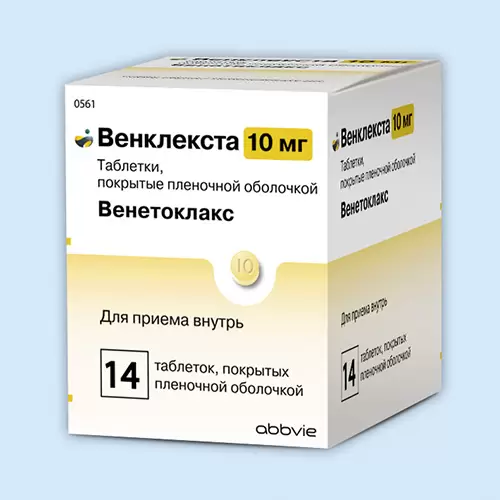
Venetoclax (Venclexta) — BCL-2 treatment for leukemia and lymphoma
What venetoclax is in simple patient language
Venclexta — brand name. Venetoclax — the drug name in medical records. A cancer tablet. Not regular chemotherapy. Not an immune drug. Also not a tablet to start by habit.
Why it comes up: in some blood cancers, abnormal cells avoid the normal “stop” signal. They keep living. BCL-2 is one of the shields behind that. Venetoclax is built to press on that shield.
The tablet is taken at home. The start is not casual. Blood counts, kidney numbers, salts in the blood, uric acid, infection signs, node size, old treatment, and the home medicine list all matter before the first step.
How venetoclax works
A healthy cell has an exit route. If it is damaged or no longer needed, the body can remove it. In CLL, SLL, and some AML plans, that exit route may be blocked.
BCL-2 helps some sick cells stay alive. Venetoclax takes away part of that help. After that, the cell may lose a survival trick it was using.
That can be useful. It can also be rough at the start. If many cells break apart quickly, blood chemistry can move. The kidneys may suddenly have extra work. That is why the first doses are planned with labs, fluids, and clear instructions.
Which diseases venetoclax may be used for
Venetoclax is not a general leukemia pill. It enters the plan only when the diagnosis, biology, previous treatment, and patient condition point in that direction.
- CLL, when a BCL-2 plan has a clear place in the treatment story;
- SLL, when the logic follows the same blood-cell pattern;
- selected AML situations, often with another leukemia drug and a lower-intensity plan;
- disease that came back or stopped responding well enough after earlier treatment;
- a second opinion when Venclexta was offered and the family needs the start, risks, and goal explained.
Same name on the report, different start. Bulky nodes, kidney function, infections, blood counts, age, strength, and other medicines can change the safest route.
When venetoclax may be especially relevant
The question is not whether Venclexta is strong. The question is what job it has now.
- CLL or SLL where the doctor is discussing a time-limited plan or a plan with an antibody;
- AML where heavy chemotherapy is not the right road, but treatment still needs to be active;
- earlier treatment no longer holds the disease well enough;
- the team has to plan around fast cell breakdown, infections, or low counts;
- the patient takes several regular medicines and the list needs a careful check.
Sometimes the drug fits the biology but the first dose still has to wait. Infection, poor kidney numbers, dehydration, or a high breakdown risk can change the order of steps.
What needs to be checked before treatment
Before venetoclax, one old summary is rarely enough. The first weeks are shaped by the details.
- exact diagnosis and the report that proves it;
- flow cytometry, biopsy, cytogenetics, or molecular tests, if done;
- all previous treatment, with dates and the reason each plan stopped;
- CBC: white cells, lymphocytes or blasts, neutrophils, hemoglobin, platelets;
- creatinine, uric acid, potassium, calcium, phosphate, liver values;
- size of lymph nodes, spleen, or other disease burden from recent imaging or exam;
- fever, infection, bleeding, shortness of breath, weakness, poor drinking, or dehydration;
- all medicines at home, including antibiotics, antifungal drugs, heart drugs, seizure pills, sleep pills, pain drugs, and supplements.
The preparation can look slow from the outside. It is not delay for no reason. With this drug, a safer start can matter as much as the tablet itself.
How treatment with venetoclax goes
Venetoclax is taken by mouth on the schedule set by the hematologist. The dose is not something to copy from another patient. The start may be gradual, especially in CLL and SLL.
At the beginning, the clinic follows labs closely. The first concern is not only whether the disease reacts. The team also checks whether the body handles the reaction safely.
During treatment, doctors usually follow:
- blood counts and how fast the abnormal cells change;
- kidney values, uric acid, and salts in the blood;
- temperature, infection signs, bruises, bleeding, and energy;
- nausea, stool changes, appetite, drinking, and weight;
- drug conflicts with the home medicine list;
- planned visits, blood tests, and sometimes marrow or imaging checks, depending on the disease.
A pause or dose change does not automatically mean failure. Sometimes it is the way to keep the plan safe. The patient should not make that decision alone.
Possible side effects
People do not all react the same. One person has mainly blood-count trouble. Another gets infections, stomach problems, or a rough start with lab changes.
- low neutrophils, anemia, or low platelets;
- fever, cough, sore throat, or another infection sign;
- tiredness, weakness, poor appetite;
- nausea, diarrhea, constipation, or belly discomfort;
- changes in uric acid, kidney values, potassium, calcium, phosphate, or liver tests;
- bruises, bleeding, or longer recovery from infections;
- fast cell breakdown at the start, mainly when disease burden is high.
Small changes can matter here. A lab drawn on time can prevent a much larger problem later.
When the treating team needs to know fast
Call the treating team the same day if any of these start:
- fever, chills, sore throat, cough, or any infection sign;
- sudden weakness, confusion, fainting, or strong dizziness;
- repeated vomiting, trouble drinking, very dry mouth, or very little urine;
- back pain, muscle cramps, racing heartbeat, or a strange heavy feeling after a dose increase;
- shortness of breath, chest pain, or breathing that worsens quickly;
- black stool, blood in urine, unusual bruises, or bleeding that does not fit the situation;
- a quick drop in general condition after starting tablets or moving to a higher dose.
Do not sit at home trying to prove Venclexta caused it. The treating team can decide that. The safer job is to report the change early.
Why venetoclax is not right for everyone
Venclexta can be an important drug. It is still not a universal pill for every leukemia or lymphoma.
- the first-dose breakdown risk is too high for the available monitoring;
- there is an active infection that needs attention first;
- blood counts are already very low before the start;
- kidney function or blood salts make the first weeks unsafe;
- another home medicine can push venetoclax exposure too high;
- the patient cannot get the needed early checks;
- the biology of the disease points to a different plan.
Choosing something else does not make Venclexta a bad drug. It may simply be the wrong tool for this week, this patient, or this risk level.
Can venetoclax be combined with other treatments
Yes. Very often the plan is not venetoclax alone. The combination depends on the disease and the patient, not on a wish to add more drugs.
- with an antibody in some CLL or SLL plans;
- with a lower-intensity leukemia drug in selected AML plans;
- with medicines that protect the kidneys and lower breakdown risk at the start;
- with infection support, transfusion support, or nausea treatment when needed;
- after earlier lines of therapy, when the sequence makes sense.
The medicine list must be checked before adding anything new. Antifungal tablets, some antibiotics, heart drugs, seizure medicines, and even supplements can change the risk.
What no quick response can mean
Response to venetoclax is not read from one good day or one bad day. In CLL and SLL, the doctor looks at blood, lymph nodes, spleen, symptoms, and tolerance. In AML, marrow checks and blood recovery may matter more than how the patient feels on one morning.
Sometimes numbers move fast. Sometimes the first visible story is low counts, infection risk, or a needed pause. That does not automatically mean the treatment is wrong.
The plan is judged by trend: disease behavior, labs, infections, side effects, dose interruptions, and the goal of this line of treatment.
Hematology consultation in Israel about venetoclax
At Tel Aviv Medical Clinic, the discussion is simple: does Venclexta really belong in this case now, or is another step needed first?
It helps when the family was told about Venclexta but the start still feels unclear. First doses, the partner drug, low counts, kidneys, infections, and home pills can all change the safest route.
Bring the records that tell the story: diagnosis paper, flow cytometry or biopsy, genetic results if there are any, old treatment dates, recent CBC and chemistry, creatinine, uric acid, electrolytes, infection notes, scans or lymph-node sizes, and every regular home medicine.
We do not choose the dose from here and we do not take over the treating doctor’s role. The point is practical: make the file readable, find the risky gaps, and give the family questions they can actually use.
Frequently asked questions — answered by Dr. Stefanska
- Is Venclexta chemotherapy?
No. I do not put it in the chemo group. Venclexta is a BCL-2 tablet. It works around a survival signal, not like old-style chemo.
But I stop on the word “tablet.” Tablets feel easy. This one is not. Before the first real step I want counts, kidney numbers, uric acid, infection story, home medicines, and the dose-rise plan in front of me.
- Why are there so many blood tests before and after the start?
The patient can look fine while the blood chemistry is already moving. I look at potassium, phosphate, calcium, uric acid, creatinine. Not for decoration.
With bulky disease, the first doses can shift those numbers fast. Better to catch it in the lab than after weakness, vomiting, little urine, or a trip to the emergency room.
- What is the fast cell-breakdown problem people warn about?
It means cells die quickly and dump material into the blood. A little of that is manageable. Too much at once can stress the kidneys and disturb the body’s salts.
This is the reason for fluids, protective pills, repeat labs, and sometimes starting under clinic observation. Annoying, yes. Optional, no.
- Can Venclexta be taken with other home medicines?
Not by guessing. Send the full list. Antifungal pills, antibiotics, heart drugs, seizure drugs, sleep tablets, pain medicine, supplements — all of it.
Some of them raise the venetoclax level. Then a normal-looking dose can behave like too much. I would rather fix the plan before the start than repair bad labs later.
- Why is venetoclax often combined with other drugs in AML?
In AML, I almost never think of Venclexta as a lonely tablet. It usually belongs inside a plan with another anti-leukemia drug, often when heavy chemotherapy is too much for the patient.
The plan can still be rough. Counts fall. Infections appear. Transfusions, pauses, marrow checks, and dose changes may become part of the month. Lower intensity is not the same as light treatment.
- What if neutrophils drop or fever appears?
Same-day call. Fever with low neutrophils is not a small cold until the team says it is safe.
The next step may be blood tests, antibiotics, a clinic check, a pause, or a dose change. No home improvising with the calendar. This is exactly the moment to report early.
- What should be prepared for a consultation about Venclexta?
Bring the disease proof, flow cytometry or biopsy, genetic reports if there are any, all treatment dates, fresh CBC and chemistry, creatinine, uric acid, electrolytes, and infection notes.
Also bring scan or node data, spleen notes, current symptoms, and every home medicine. The best extra page is simple: diagnosis date, each treatment, response, relapse, side effects, today’s question.
Important information
This material is general medical information. It is not a treatment prescription. Venetoclax can be discussed only after review of the diagnosis, tests, disease burden, previous therapy, kidney function, infection risk, blood counts, and medicine interactions.
Do not start, stop, restart, or change the dose without the treating physician.
Contacts
For a consultation about Venetoclax:
📞 +972-73-374-6844
📧 [email protected]
💬 WhatsApp: +972-52-337-3108
