


 Contact Us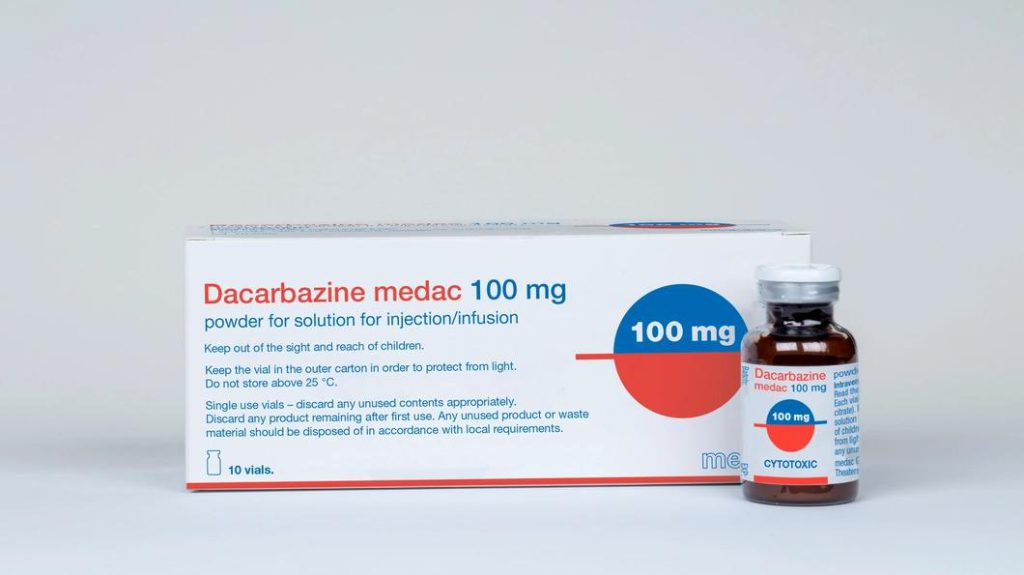
Dacarbazine — chemotherapy for melanoma and Hodgkin lymphoma
What dacarbazine is in simple patient language
DTIC is an older short name for this drug.
It is used when a cancer has spread and needs to be fought systemically. No targeted receptor, no immune pathway.
Stage, prior lines of treatment, and what the plan needs to achieve right now all shape the answer. For some patients this drug still fits. For others, something else goes first.
How dacarbazine works
Cell division requires copying genetic material first. Dacarbazine produces substances in the body that damage that material at a key moment. The cell cannot proceed past that point.
Rapidly dividing healthy cells are caught in this too — that is why it is called chemotherapy and not a targeted drug. Blood, liver, and overall physical status are all tracked on a fixed schedule throughout the course.
Most patients expect the drip day to be the worst. With dacarbazine, nausea, fatigue, and count drops often build over the days that follow. The follow-up period matters as much as the infusion itself.
Which conditions may be treated with dacarbazine
Dacarbazine shows up in oncology when systemic chemotherapy is what the clinical picture calls for:
- metastatic melanoma
- Hodgkin lymphoma within a multi-drug protocol
- certain soft tissue sarcomas depending on the clinical situation
- disease that came back or kept moving after prior lines of therapy
- cases where the team is comparing chemo to other systemic options
Same diagnosis on paper does not mean same plan. Current blood results, disease pace, and prior treatment all push the decision in different directions.
When dacarbazine can be especially relevant
Usually when the situation calls for something systemic and there is a specific clinical reason chemotherapy is the direction:
- the cancer has spread beyond one area
- a previous regimen lost its grip on the disease
- a combination protocol for Hodgkin lymphoma is being assembled
- more recent treatment options are unavailable or have already been exhausted
- a clear next step needs to be established quickly
- a second opinion on a proposed plan is being sought
The drug name alone tells you nothing useful. What matters is the reasoning behind proposing it at this specific point in time.
What should be checked before treatment
A summary sheet with a diagnosis on it is not enough. The oncologist needs a real clinical review.
- precise diagnosis and pathology findings
- current disease stage and spread
- recent CT, MRI, or PET-CT
- complete blood count with differential
- liver and kidney values
- all prior therapy and how the patient tolerated it
- active infections, major weight loss, or pronounced weakness
- all current medications
- history of severe nausea and dehydration risk
Sometimes this review shifts the plan. Liver values that are not stable, marrow that has not bounced back from the last course, or a patient who was hit hard by prior chemotherapy — any of these can change the timing or the choice entirely.
How treatment with dacarbazine is usually given
It goes in via IV. The schedule — how many days, how far apart — depends on the diagnosis, what other drugs are being given alongside, and which line of therapy this is.
Labs and patient condition are reviewed before each infusion. The team keeps watch during the drip. Delayed reactions are tracked across the days that follow.
- white cells, neutrophils, hemoglobin, platelets
- liver markers
- kidney function
- nausea, appetite, how much the patient is drinking
- temperature and any signs of infection
- disease response through imaging
- how well the full regimen is being tolerated when combined
When counts drop harder than expected or side effects go beyond what was planned, the next date gets pushed, support is added, or the approach gets reviewed. Adjusting the schedule is clinical management, not a failure of the plan.
What reactions can occur during treatment
Each patient goes through this differently. Some manage with mild fatigue and occasional nausea. Others need more active support from the start. The risk profile for each person gets assessed before the first infusion.
- nausea and vomiting — often pronounced
- poor appetite
- fatigue and physical weakness after each course
- white cell, neutrophil, or platelet drops
- raised infection risk
- liver marker changes
- fever or a flu-like feeling
- irritation at the IV site
- skin rash or itching
- hair loss, more frequent with combination regimens
A lot of this can be softened with the right preparation: anti-nausea drugs started before the infusion, fluid monitoring, timed blood draws, and a clear line to the team when something shifts.
When to reach the medical team the same day
These should not wait for a scheduled appointment:
- temperature hitting 38 degrees or above
- chills or a sudden hard drop in how the patient feels
- vomiting that keeps returning or makes drinking impossible
- clear signs of dehydration
- bleeding or bruising that has no obvious cause
- blood appearing in urine or stool
- skin or eyes turning yellow
- sharp pain in the abdomen
- chest pain or trouble breathing
- a rash spreading across the skin, facial swelling, or any sign of an allergic reaction
Some complications during chemo move quickly. Early contact with the team is what keeps a manageable situation from getting out of hand.
Why dacarbazine does not suit every patient
In melanoma, immune drugs and mutation-targeted agents are now often where the conversation starts. In Hodgkin lymphoma, the full protocol is what matters, not one drug inside it. Dacarbazine is not a universal fallback.
- tumor type and stage
- prior lines of treatment
- how fast the disease is moving
- current blood count levels
- liver and kidney function
- overall physical condition
- whether a better-suited option exists
- the treatment goal: holding the disease, preparing for another step, or managing symptoms
Sometimes dacarbazine is genuinely the right next move. Other times something else fits better. Neither outcome is unusual in oncology. It is how these decisions actually get made.
Can dacarbazine be combined with other treatments
Yes, and in Hodgkin lymphoma it almost always is. The doctor may also discuss combining it with:
- other chemotherapy agents in the protocol
- anti-nausea support medication
- blood count protection when that risk is present
- radiation in specific clinical situations
- a monitoring plan or a change in approach based on how the disease responds
Every addition to a treatment plan needs to earn its place. More drugs without a defined purpose means more toxicity without more benefit.
What it means when there is no quick response
Patients often want a clear answer after the first cycle. Chemotherapy does not work on that timeline.
Sometimes symptoms ease before imaging changes. Sometimes the scan looks better only after several weeks. Sometimes the meaningful result is that nothing is getting worse. And sometimes after a few cycles the data points toward changing the approach.
These assessments are built from scans, labs, how the patient is handling treatment, symptom trends, and disease pace — all read together over time, not from a single visit.
Oncology consultation in Israel
Tel Aviv Medical Clinic sees patients where dacarbazine is part of the clinical question — melanoma, Hodgkin lymphoma, sarcoma, or situations following prior treatment.
A consultation may be useful when:
- the reasoning behind proposing dacarbazine is not clear
- chemotherapy needs to be weighed against more recent treatment options
- a second opinion on the regimen is needed
- blood results need to be reviewed before a decision is made
- the history of prior treatment tolerance needs to be unpacked
- questions need to be organized before the next appointment with the treating oncologist
- treatment in Israel or a review of an existing plan is being considered
We do not prescribe remotely and do not replace the treating physician. We help patients and families get a clear understanding of the medical reasoning and go into the next clinical conversation ready.
Frequently asked questions — answered by Dr. Stefanska and Dr. Meerovich
- Is dacarbazine still being used for melanoma?
Yes, in certain situations. The field has shifted considerably over the last ten years though. Checkpoint inhibitors and drugs aimed at specific mutations tend to go first for most melanoma patients now. Dacarbazine enters the picture when those have already been tried, are not available, or do not match the tumor biology. When a family raises this question with me, I want to know two things first: what else has been evaluated, and what is the specific reason this drug is coming up at this point.
- Is it given without other drugs in Hodgkin lymphoma?
Almost never. In Hodgkin lymphoma it is one component of a multi-drug protocol, and that full protocol is what you need to evaluate — not the individual pieces. Before I comment on dacarbazine in that context I need to know the treatment phase: initial therapy, a relapse, a bridge before something else, or a revision of a plan that changed. Each of those leads somewhere different.
- Why does anti-nausea support matter so much here?
Nausea with this drug can hit hard. Giving anti-nausea medication before the drip starts is not optional \u2014 it is built into the protocol. Once a patient is already vomiting, catching up is slow. If they cannot drink and keep losing fluid, lab results shift, strength drops, and the next cycle becomes harder to manage. Support before symptoms start is not extra care. It is the plan.
- How do you assess whether the treatment is actually doing something?
Not from one result. I look at scans across several time points, blood trends, what symptoms are doing, and how fast the disease was moving before treatment started. Shrinkage on imaging is one answer. Nothing progressing is another. If after several cycles the picture does not justify continuing, the plan changes. That is a data call, not a gut feeling.
- Can a course go ahead when blood counts are already reduced?
I need to understand what brought them down. The tumor, a recent treatment course, an infection, or something unrelated \u2014 each of those points somewhere different. A short pause may fix it. Or the risk of proceeding is real and a different drug is the right call. I ask why before I decide anything.
- What separates dacarbazine from immune-based treatments?
Not the same thing at all. Dacarbazine targets cells mid-division. Immune drugs work through the patient’s own defenses and how the body reads the tumor. Side effects differ, timelines differ, monitoring differs. One does not fill in for the other. The choice comes from tumor type, biology, and treatment history.
- What should be done if nausea or fever develops after a course?
Ring the team that day. Not the next morning. A fever when white cells are already low can mean an infection has started. Vomiting that stops normal drinking needs to be addressed before it turns into a bigger problem. Do not handle either at home without speaking to someone first. A blood test is almost always step one.
Important information
This page contains general medical information only. It is not a treatment recommendation. Dacarbazine may be considered only after reviewing the diagnosis, disease stage, imaging, blood counts, prior treatment, and the patient’s overall condition.
Do not start, stop, or change any treatment without speaking to your treating physician first.
For a consultation about dacarbazine:
📞 +972-73-374-6844
💬 WhatsApp: +972-52-337-3108