


 Contact Us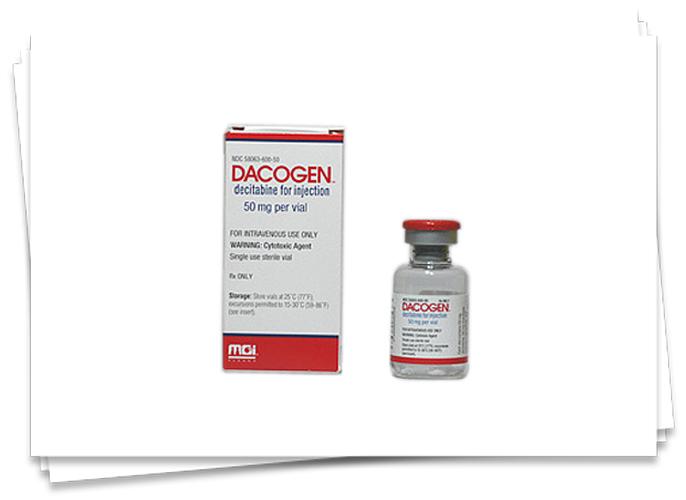
Decitabine (Dacogen) — hypomethylating agent for blood cancers
What Decitabine is in simple patient language
Dacogen on the packaging. Decitabine in the clinic notes. The drug sits in the hypomethylating agent class alongside azacitidine — same general mechanism, different molecule, different schedule. It does not work by directly poisoning dividing cells. It targets a layer of chemical instruction that sits on top of the DNA sequence and controls which genes get read. In blood cancer cells that layer has gone badly wrong. Growth-suppressing genes and maturation signals get buried under silencing marks that should not be there. Decitabine clears those marks away, over time.
Three things tend to catch patients off guard. First, how the drug is given — decitabine runs intravenously over one hour for five consecutive days every four weeks, or in a shorter daily schedule depending on the protocol. Second, how long before anything shifts. Three to four months before blood counts start responding is a normal timeline. Stopping after cycle two because nothing looks different is one of the most common ways treatment fails to deliver. Third, the open-ended nature of it. There is no planned finishing point. It runs as long as the disease is responding and the patient is tolerating it.
Kidney function, liver function, performance status, disease risk, and whether intensive chemotherapy is realistically an option — all of this goes into the decision before the first infusion.
How Decitabine works
Genes can be switched off without touching the DNA letters themselves. Small chemical groups attach to stretches of the strand and shut down nearby genes. In cancer cells these silencing marks end up on the wrong genes — the ones that should be putting the brakes on growth or telling cells to mature.
Decitabine rides into replicating cells on the same transport proteins that carry natural nucleosides. Once inside, it gets incorporated into the DNA strand. The enzymes that would normally add new silencing marks to the daughter strand during copying can no longer attach properly to decitabine-containing DNA. The marks are not renewed. They dilute out over repeated cell divisions.
The effect builds cycle by cycle. It is not visible in the first few weeks. That is not the drug failing — it is how the mechanism works.
Which conditions may be treated with Decitabine
Decitabine is used in blood disorders, primarily in adults.
- myelodysplastic syndromes — the main setting; used across risk categories with the clearest benefit in patients whose disease is progressing or carries higher-risk features
- AML in patients where standard intensive induction is not appropriate — older age, organ impairment, or comorbidities that make the treatment too dangerous
- chronic myelomonocytic leukaemia — in patients with progressive or symptomatic disease
- AML post-transplant maintenance — in selected patients to reduce relapse risk after allogeneic stem cell transplant
Decitabine and azacitidine share a class but are not the same drug. The molecule, schedule and route all differ. The choice between them depends on clinical context, local practice and what works for the patient.
When Decitabine can be especially relevant
Certain situations bring it into the picture.
- MDS with falling counts, rising blast percentage, or transfusion needs that have been climbing
- AML in a patient over 70 or with health problems that make intensive chemotherapy too risky
- a clinical situation where IV administration is preferable or more practical than subcutaneous injections
- AML post-transplant where maintenance is being planned
- second opinion requests on whether decitabine or azacitidine is a better fit at this stage
The comparison between decitabine and azacitidine in any individual patient is not settled by a simple rule. Schedule, patient tolerance, local formulary, and specific disease features all play a role. If the treating team has proposed one without discussing the other, that comparison is worth raising.
What should be checked before treatment
A full picture is needed before the first infusion.
- bone marrow biopsy with cytogenetics and mutation panel — mutation findings now shape whether a targeted drug should be added from the start
- disease risk score in MDS — determines urgency and what treatment is trying to achieve
- full blood count and transfusion history
- kidney function — decitabine clears renally; impaired clearance changes how it is dosed
- liver function
- performance status and comorbidity profile
- current medications
- vaccination history — live vaccines are not given during treatment
- fertility discussion where applicable
Mutation testing carries increasing weight. Specific mutations found before starting may point toward adding venetoclax or a targeted inhibitor from the start. That belongs in the initial planning.
How treatment with Decitabine is usually given
Decitabine goes in intravenously over one hour. The standard schedule is once daily for five consecutive days, repeated every 28 days. Some centres use a ten-day schedule, particularly in AML, though the five-day course is more widely used.
Unlike azacitidine, decitabine is not available as a subcutaneous injection in most countries. IV is the standard route. Each infusion is short but the five-day block means five visits to the day unit or a short admission each cycle. Treatment has no fixed end. It continues for as long as the disease is responding and the side effects are manageable.
During treatment the team monitors:
- full blood count before every cycle — counts fall in the early cycles before recovering; that drop is expected
- kidney and liver function at regular intervals
- bone marrow biopsy after four to six cycles to formally assess response
- signs of infection in the days after each five-day course when neutrophils are lowest
- transfusion requirements over time — a falling need for transfusions is one of the earliest useful signals
- how the patient is managing the five-day infusion schedule between cycles
Early count drops are part of the treatment, not a sign of failure. The marrow is being disrupted before it starts producing more normally. Stopping on the basis of counts alone in the first two cycles, without a marrow assessment, is almost always premature.
Possible side effects
Neutropenia after each five-day course is the side effect that drives most of the clinical monitoring.
- neutropenia — counts fall in the days after each course; infection risk peaks in that window
- thrombocytopenia — platelet counts fall; bruising and bleeding risk follow
- anaemia — red cell transfusions may be needed, particularly in the early cycles
- nausea — usually mild; antiemetics are given routinely
- fatigue — accumulates across the first months, typically eases as counts recover
- fever — can be a drug effect or a sign of infection; both need assessment
- diarrhoea or constipation in some patients
- infusion site reactions — less common than injection site reactions with azacitidine
Rare but serious:
- severe infection during the post-course neutropenic window
- kidney toxicity — more relevant when renal function was already reduced at baseline
- rapid breakdown of cancer cells at the start of treatment in AML with very high blast counts
Fever in the week after the five-day course is not ordinary illness. Neutrophil counts can be close to zero at that point. Calling the haematology team the same day is the right response — not waiting to see how it develops.
When to contact a doctor urgently
Some things during decitabine treatment should not wait.
- temperature above 38 degrees — same-day call regardless of how the patient otherwise feels
- bleeding that is not settling on its own
- sudden worsening of breathlessness or general condition
- infection symptoms that are getting worse not better
- any sudden change that falls outside the pattern of previous cycles
The five to ten days after each course are when the infection window is open. A fever in that period is a medical situation until proven otherwise.
Why Decitabine is not right for every patient
Diagnosis fitting does not settle the question.
- severe liver impairment — affects how the drug is metabolised
- severe kidney impairment — clearance is renal; significant reduction changes dosing safety
- stable lower-risk MDS with minimal transfusion dependence — the treatment burden may not be warranted
- patients who cannot attend for five consecutive infusion days each month — the schedule requires consistent presence
- situations where intensive chemotherapy or a targeted drug is a better fit for the disease biology
In lower-risk stable MDS, watchful waiting is a legitimate option. The decision to start should be driven by disease trajectory, not the presence of an abnormal marrow result alone.
Can Decitabine be combined with other treatments
Yes — increasingly so.
- venetoclax — the decitabine-venetoclax combination is used in AML patients not suitable for intensive induction; same principle as the azacitidine-venetoclax combination, with deeper neutropenia and its own monitoring requirements
- targeted inhibitors for specific mutations — added in AML with relevant enzyme changes
- cedazuridine — a newer oral formulation pairs decitabine with a metabolic inhibitor so it can be taken by mouth rather than infused; available in some countries as a combined tablet
- checkpoint inhibitors — being studied in clinical trials
The oral decitabine-cedazuridine tablet removes the need for infusion visits where available. Not everywhere, but worth asking about. Adding venetoclax produces higher AML response rates but deeper, longer neutropenia — a more demanding regimen that requires closer monitoring.
What no quick response can mean
Response in MDS and AML on decitabine is assessed by bone marrow biopsy after four to six cycles. Blood count trends — transfusions less frequent, neutrophils edging up — give early directional signals but do not replace marrow assessment.
No response after six cycles marks the end of what decitabine can offer for that patient. What follows depends on mutation profile, fitness, and what trials are available. Planning that conversation should start before the sixth cycle closes, not after the marrow result comes back without a response.
Oncology consultation in Israel
Tel Aviv Medical Clinic offers haematology consultations and second opinions for patients on decitabine or being considered for it. Worth seeking when the choice between decitabine, azacitidine and intensive treatment has not been worked through, when response has been slower than expected, when adding venetoclax or a targeted agent is being discussed, or when an independent view on the current plan would be useful.
The consultation can cover:
- pathology, cytogenetics and mutation panel review
- risk score assessment and treatment goal clarification
- decitabine versus azacitidine comparison for this specific patient
- combination options with venetoclax or targeted agents
- response assessment and next steps if treatment is not working
- second opinion on the current protocol
- questions to bring back to the treating haematologist
We do not replace the treating doctor. We help the patient arrive at the next conversation knowing what to ask.
Frequently asked questions — answered by Dr. Stefanska and Dr. Meerovich
- What is the difference between decitabine and azacitidine?
Both are hypomethylating agents working by stripping silencing marks off genes. Decitabine goes in intravenously for five days every four weeks. Azacitidine is most commonly given by subcutaneous injection for seven days every four weeks. The molecules differ, the schedules differ, and there are differences in side effect patterns. Head-to-head trials have not shown one clearly better than the other. The choice depends on clinical situation, local practice and sometimes on which schedule works better for the patient.
- Why does response take so long?
Decitabine changes how cancer cells read their DNA. It does not destroy them on contact. Silencing marks that have accumulated over months clear out gradually across repeated cycles. The marrow shifts slowly. Three to four months before blood count improvement is a normal and expected timeline. Stopping at cycle two because nothing has changed yet is the most common way to walk away from a treatment that was working its way toward a response.
- What is the oral version of decitabine?
Cedazuridine blocks the enzyme that breaks decitabine down in the gut before it reaches the bloodstream. Taken together as a daily tablet, the combination delivers the same drug exposure as IV without infusion visits. Available in some countries, being evaluated in others. Where it is an option, it changes the practical experience of treatment significantly — five clinic days a month versus a tablet at home.
- How is the venetoclax combination used with decitabine?
Venetoclax blocks a protein cancer cells use to stay alive. Decitabine reprograms how those cells read their genes. Together they hit leukaemia from two directions and produce higher response rates in older AML. The cost is deeper, longer neutropenia. Antibiotic and antifungal prophylaxis and frequent blood monitoring are standard parts of the combination.
- What documents should I bring for a second opinion?
Bone marrow biopsy and aspirate reports from diagnosis and any follow-up assessments, with cytogenetics and mutation results. Blood counts over time. Transfusion records. Full treatment list with drugs, doses, cycle numbers and dates. Recent bloods with kidney and liver function. Significant side effects and how they were managed. If on venetoclax alongside decitabine, the current dose and any adjustments made.
Important information
This page gives general medical information. It is not a personal treatment plan. Decitabine should be discussed only after review of the diagnosis, disease subtype, risk score, mutation profile, kidney and liver function, and the patient’s overall condition.
Do not start, stop or change treatment without your treating oncologist.
For consultation about Decitabine treatment:
📞 +972-73-374-6844
💬 WhatsApp: +972-52-337-3108