


 Contact Us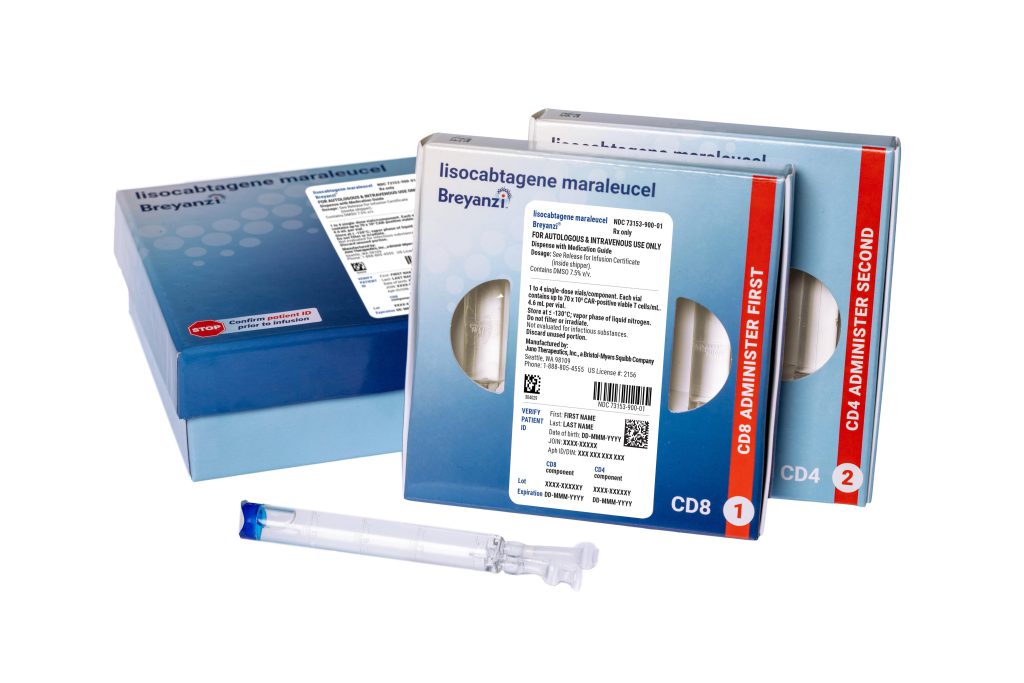
Lisocabtagene maraleucel (Breyanzi) — CAR T-cell therapy for blood cancer
What is lisocabtagene maraleucel (Breyanzi) in simple words
Lisocabtagene maraleucel, sold as Breyanzi, is not a usual infusion drug kept on a shelf. It is made from the patient’s own immune cells.
Those cells are collected, re-trained in a laboratory, and sent back with a new task: to recognise a marker called CD19 on certain B-cell cancers. After that, they can keep looking for malignant B-cells inside the body.
For families comparing cell therapy options, Breyanzi is usually a timing conversation. It is about whether the cancer can be held long enough, whether cells can be collected, and whether the patient can tolerate the early weeks after infusion.
That sounds simple when said quickly. In real life it is a planned hospital pathway, not a single appointment. The diagnosis, previous treatment, current fitness and timing all matter.
How Breyanzi works
The idea behind Breyanzi is to give T-cells a clearer address. Many B-cell cancers carry CD19. By adding a receptor that can notice that marker, the treatment helps the immune system focus its attack.
Breyanzi is unusual because the final product contains two T-cell groups prepared in a defined way. This does not make it “mild”. It only means the treatment is built with a controlled cell composition.
Once infused, the cells may expand for a while. That is the moment when the team becomes very watchful. A rising temperature, sudden weakness, muddled speech or harder breathing can be an early hint that the immune reaction is running too hot.
What conditions Breyanzi is used for
Breyanzi may be discussed in selected adults with B-cell blood cancers where CD19 is relevant. In practice, this can include:
- aggressive large B-cell lymphoma after earlier treatment has failed;
- disease that returned soon after first-line therapy;
- large B-cell lymphoma in patients who cannot move safely to transplant;
- follicular lymphoma after several treatment attempts;
- mantle cell lymphoma after modern targeted therapy;
- CLL or SLL after both BTK and BCL-2 directed treatment;
- marginal zone lymphoma after repeated systemic treatment.
The diagnosis opens the door, but it does not make the decision. The real question is whether this patient, with this disease speed and this treatment history, can safely reach and pass the CAR T window.
When Breyanzi may be especially relevant
The question usually comes up when standard treatment has already lost control, or when the chance of durable remission with another routine option looks limited.
It may become relevant when:
- the cancer came back after chemotherapy or antibody treatment;
- the response to the last treatment was too short;
- transplant is not realistic or has already failed;
- the tumour still shows B-cell features;
- the patient is fit enough for a CAR T pathway;
- bridging treatment can hold the disease while cells are made.
This is why timing matters so much. If the team waits until the illness is completely out of control, the window may close. If the move is made too early, a patient may lose a simpler option that still had value.
What needs to be checked before starting treatment
Before Breyanzi is planned, the oncology team usually wants a clear picture, not just a previous diagnosis written in a report.
- recent biopsy or pathology review;
- CD19 status if there is any doubt;
- PET-CT or CT to map active disease;
- blood counts and chemistry;
- heart and lung assessment;
- liver and kidney reserve;
- infection screening;
- neurological history;
- previous therapies and how the cancer behaved after each.
One practical detail is easy to underestimate: the patient has to stay steady while the cells are being prepared. If the disease is pushing hard, a temporary holding plan may be needed before the infusion ever happens.
How treatment is carried out
Breyanzi treatment starts with cell collection. Blood passes through an apheresis machine, and the needed immune cells are separated. The rest goes back to the patient.
After manufacturing, the patient receives short chemotherapy to make space for the returning cells. This is not meant to be the main cancer treatment. It prepares the body for the CAR T infusion.
The infusion itself is usually short. The serious part is the observation period after it. Nurses and doctors follow temperature, circulation, breathing, blood tests and even small changes in speech or alertness.
Monitoring usually focuses on:
- early immune reactions;
- confusion or speech changes;
- infection signs;
- blood count recovery;
- need for transfusions;
- tumour response on later scans.
Possible side effects
CAR T therapy can cause side effects that feel very different from ordinary chemotherapy. Some are expected and manageable. Some need immediate hospital care.
Possible problems include:
- fever or chills;
- sudden circulation drops;
- breathing that needs support;
- confusion or unusual sleepiness;
- headache or tremor;
- low white cells, red cells or platelets;
- infections;
- tiredness that lasts longer than expected;
- changes in liver tests.
The two reactions doctors watch most closely are an over-heated immune response and nervous-system changes. They are different problems, but both can move quickly. That is why monitoring after infusion is not a formality.
When to contact a doctor urgently
After Breyanzi, small changes can matter. The safest rule is to report early, especially during the first weeks after infusion.
Contact the treatment team urgently if there is:
- temperature rise;
- dizziness or faintness;
- shortness of breath;
- new confusion;
- difficulty finding words;
- seizure or shaking episode;
- severe weakness;
- unusual bleeding or bruising;
- fast worsening at home.
With CAR T, calling too early is rarely a problem. Calling late can be.
Why Breyanzi is not right for everyone
Breyanzi can be a strong option, but it is not a shortcut around careful selection. Some patients need another treatment first. Some need stabilisation. Some may be too frail for the risks involved.
The decision may be affected by:
- rapidly progressing disease;
- uncontrolled infection;
- poor organ reserve;
- active brain involvement;
- very low blood counts;
- recent intensive treatment;
- lack of a safe waiting window.
There is also the practical side: cell collection, manufacturing, admission, caregiver support and access to an experienced centre. These details are not paperwork. They decide whether treatment can be delivered safely.
Can Breyanzi be combined with other treatments
Breyanzi is usually not given as just one piece in a long combination regimen. It is a personalised cell therapy with its own preparation and follow-up.
Other treatments may still be used around it. A patient may need bridging therapy while waiting. Some may need supportive medicines after infusion. Later, if the cancer returns, the next step depends on how long the response lasted and what the disease looks like then.
The sequence matters more than the number of drugs. A plan that looks aggressive on paper is not always the smartest plan for the patient in front of you.
What “no quick response” to treatment means
Response after CAR T is not judged by one good or bad day. Symptoms may fluctuate while the immune reaction settles. Blood counts may be low. The first weeks can look messy.
Doctors usually put several clues together: scans, blood tests, symptoms, strength, infection pattern and how the patient looks from one week to the next.
Sometimes the first assessment is mixed. Sometimes the disease is already quieter. Sometimes it is clear that another plan is needed. What matters is not one isolated result, but the direction the whole picture is taking.
Oncology consultation for Breyanzi in Israel
At Tel Aviv Medical Clinic, a consultation can help make the Breyanzi discussion less abstract: whether the disease stage fits, whether the timing is sensible, and what should be clarified before a CAR T referral.
A useful second opinion should answer three practical questions: is CAR T still realistic, what could block it, and what should be done now rather than after the next scan.
This may be useful if you need to:
- review the diagnosis and previous treatment history;
- understand whether CAR T is being considered at the right time;
- compare Breyanzi with other cell therapy options;
- discuss bridging treatment before infusion;
- check whether additional tests are needed;
- prepare questions for the treating haematologist.
The aim is not to promise treatment from a distance. It is to make the reasoning clear, so the patient and family understand what has to be checked before the next decision becomes urgent.
Frequently Asked Questions — Dr. Stefanskoy
- Is Breyanzi the same kind of treatment as chemotherapy?
No. Chemotherapy acts directly on dividing cells. Breyanzi is different because the patient’s own immune cells are changed outside the body and then returned. That is why the process takes longer and why monitoring after infusion is so important. It is not “lighter” than chemotherapy. It is simply a different type of risk.
- Why does the treatment take time to prepare?
Because the product is made for one person. The cells have to be collected, processed, checked and shipped back. During that period the disease must stay under enough control. This is why doctors often discuss bridging treatment. It is not a failure of the plan. It is a way to keep the patient safe while the main treatment is being prepared.
- What makes a patient a good candidate for Breyanzi?
I look first at the disease history: what was tried, how long each response lasted, and how fast the cancer is moving now. Then I look at the person in front of me. Can they manage hospital monitoring, infection risk and a difficult recovery period? CAR T is not chosen only because the cancer has returned. It is chosen when the whole picture supports it.
- Is CD19 testing always needed?
In many B-cell cancers the marker is expected, but I still want to know whether the biology still fits the treatment. Cancer can change after several therapies. If the report is old, incomplete or unclear, repeating or reviewing the pathology can be very useful. A small missing detail can change the plan.
- What is the most worrying early side effect?
The early concern is not one single symptom. It is the pattern: fever, sudden weakness, breathing trouble, confusion, odd behaviour or a person who simply looks different from yesterday. These changes may appear quickly. A good CAR T centre expects them. The key is not to wait at home and hope it passes.
- How soon do doctors know if Breyanzi worked?
Usually not immediately. The first days are about safety. Later, scans and blood tests start to show whether the disease is responding. I also care about recovery: appetite, strength, fever pattern, infections, blood counts. A scan is important, but it is not the whole patient.
- Can Breyanzi be used after another CAR T treatment?
Sometimes this question comes up, but it is not a routine answer. We need to know which target was used, how the disease returned, whether CD19 is still present and what condition the patient is in now. Repeating a similar idea without checking the biology is not good medicine.
- What should families prepare before CAR T therapy?
Families should prepare for logistics as much as for the infusion itself. There may be hospital visits, a need to stay close to the treatment centre, restrictions on driving, infection precautions and a period when the patient should not be left alone. This is not meant to scare people. It helps them plan properly.
Important information
This page is for general medical understanding only. It is not a prescription, treatment plan or replacement for a consultation with a haematologist or oncologist.
Breyanzi may only be considered after review of diagnosis, disease behaviour, previous therapy, test results and the patient’s general condition.
To arrange an oncology consultation regarding CAR T-cell therapy and possible treatment options in Israel:
📞 +972-73-374-6844
📧 [email protected]
💬 WhatsApp: +972-52-337-3108