


 Contact Us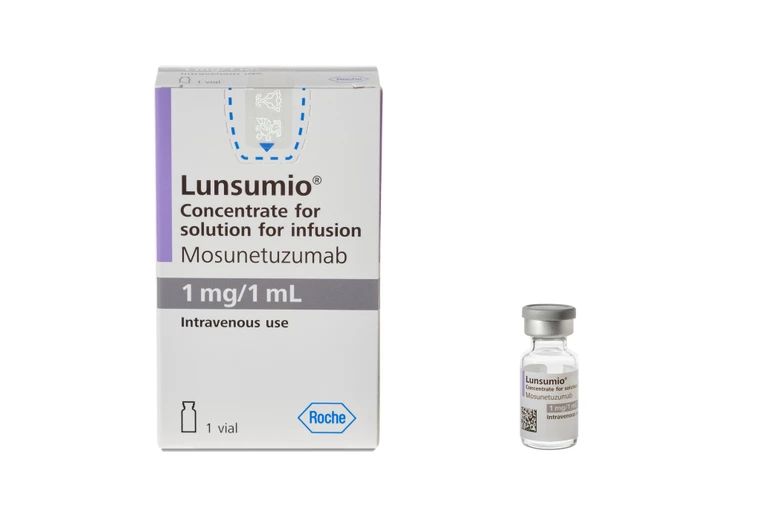
Mosunetuzumab (Lunsumio) — bispecific immunotherapy for follicular lymphoma
What is mosunetuzumab (Lunsumio) in simple words
Mosunetuzumab (Lunsumio) — a drug that forces the immune system to confront lymphoma cells directly.
It is a bispecific antibody — a molecule with two different binding ends. One attaches to a marker on lymphoma cells. The other attaches to a marker on immune cells. When both ends are connected, the immune cell is held against the lymphoma cell and destroys it.
This drug is used primarily in a slow-growing type of B-cell lymphoma that tends to return after treatment. Most often it comes up when two or more prior treatment attempts have already been made and the disease has come back.
One practical distinction from most other treatments in this setting: mosunetuzumab runs for a defined number of sessions — around eight — and then stops. Patients have a clear end point from the start.
How mosunetuzumab works
Lymphoma cells in this setting carry a surface protein that serves as a docking point for one end of the drug. The other end attaches to a protein on immune cells. Once both connections are made, the immune cell is held directly against the lymphoma cell and destroys it.
The drug effectively acts as a physical bridge between the two cell types — forcing an encounter that the immune system was not producing effectively on its own.
This is different from checkpoint inhibitors, which remove suppressive signals. Mosunetuzumab does not just unlock immune cells — it directs them to a specific location. That distinction shapes both how it works and what side effects to expect.
What conditions mosunetuzumab is used for
Mosunetuzumab is used in:
- a slow-growing B-cell lymphoma — after two or more prior treatments have been tried;
- the same lymphoma type that returned after prior therapy including a targeted antibody and chemotherapy;
- other returning B-cell lymphomas — within clinical trials in selected cases.
The slow-growing B-cell lymphoma setting is where this drug has its clearest evidence. Clinical data in patients who had already gone through multiple treatment lines showed responses — including cases where the disease disappeared completely — that persisted over time. For a patient population with few remaining options, those results were meaningful.
The fixed-course element matters practically. Eight treatment sessions, then stop. Patients know the endpoint from the beginning.
When mosunetuzumab may be especially relevant
It tends to come up when:
- this type of lymphoma has returned after two or more prior treatment courses;
- prior treatment already included a targeted antibody and chemotherapy;
- CAR-T cell therapy is not accessible or suitable for this patient;
- a defined treatment course is preferred over open-ended maintenance;
- the patient needs a practical option without the CAR-T manufacturing timeline.
The comparison with CAR-T comes up frequently. CAR-T requires a manufacturing process — immune cells are collected, modified in a laboratory, and returned weeks later. Mosunetuzumab is a ready-made drug given by infusion on a standard schedule. For patients where the CAR-T timeline is too long, or the process too complex, this offers a meaningful alternative with comparable response data in this disease setting.
Sometimes this becomes relevant not because it is the best option theoretically, but because it is the option that can actually happen given the patient’s circumstances.
What needs to be checked before starting treatment
Before mosunetuzumab is considered, the oncologist will typically review:
- confirmed lymphoma subtype and CD20 status;
- prior treatment history — what was used and how the lymphoma responded;
- disease extent and current staging;
- liver function;
- kidney function;
- blood count;
- infection status — active infections need to be managed first;
- autoimmune history;
- performance status.
One specific thing I check before starting: whether the lymphoma still carries the surface marker that one end of the drug targets. After multiple prior treatments — particularly those that already targeted the same marker — that marker can sometimes disappear from the tumour cells. If that has happened, the drug no longer has a functional target. I verify the current status rather than relying on results from the original biopsy, especially in patients with a long treatment history.
How treatment is carried out
Mosunetuzumab is given intravenously. The first session uses a gradual dose increase — beginning lower and stepping up over the first few infusions. This approach reduces the risk of a strong immune reaction before the body has adjusted to the drug.
After that initial phase, subsequent sessions run on a consistent dose every three weeks. Total treatment runs to eight sessions.
Monitoring during treatment:
- temperature and vital signs closely after each infusion — especially early cycles;
- blood count;
- liver function;
- signs of cytokine release — fever, blood pressure changes, breathing;
- neurological status;
- imaging to assess response.
The first cycle carries the highest risk of a cytokine release reaction. I hospitalise patients for at least the first infusion — sometimes longer depending on how they respond. After the step-up phase, the risk profile becomes more manageable and outpatient administration is usually appropriate.
Possible side effects
What patients may experience during treatment:
- immune activation reaction — fever, drop in blood pressure, breathing changes;
- neurological effects — confusion, difficulty speaking;
- fever and infection risk;
- low blood counts;
- fatigue;
- headache;
- nausea;
- skin reactions.
Cytokine release syndrome and neurological effects are the two that need immediate attention. Most cases of cytokine release with mosunetuzumab are mild or moderate. Severe cases are less common than with some other bispecific agents in more aggressive lymphomas. But mild does not mean ignorable — any new fever after an infusion means contacting the medical team that day.
When to contact a doctor urgently
Contact your doctor immediately if any of the following appear:
- fever — any temperature above 38°C after an infusion;
- confusion or difficulty thinking clearly;
- difficulty speaking or finding words;
- significant drop in blood pressure — dizziness, faintness;
- difficulty breathing;
- rapidly increasing weakness;
- sudden significant deterioration.
With bispecific antibodies, the window between early symptoms and a serious reaction can be short. Calling early is always the right decision. Missing the early window is where outcomes get harder to manage.
Why mosunetuzumab is not right for everyone
What affects whether this drug is appropriate:
- lymphoma subtype other than follicular — evidence here is in follicular lymphoma specifically;
- CD20 expression lost after prior anti-CD20 therapy;
- active severe infection;
- active severe autoimmune disease;
- prior organ transplant;
- poor performance status.
Follicular lymphoma is generally a slower-moving disease. When it has returned for the third time, the pace is sometimes still measured enough that the goal is long remission rather than rapid tumour control. Mosunetuzumab fits that goal. In faster-moving situations, different approaches are usually more appropriate.
Can mosunetuzumab be combined with other treatments
In its current approved indication, mosunetuzumab is used as monotherapy. Research into combinations — including with other lymphoma agents — is ongoing in clinical trials.
Whether radiation to a specific site can be used alongside or around mosunetuzumab depends on the individual situation and is discussed case by case.
What ‘no quick response’ means
Response is assessed through imaging after a defined number of cycles. Some patients show early improvement. Others respond more slowly — particularly in follicular lymphoma, where immune responses can build gradually.
I review imaging alongside how the patient feels and any symptomatic changes. A single scan mid-course is informative but not the final word. The end-of-treatment assessment tells a clearer story.
Oncology consultation for mosunetuzumab (Lunsumio) in Israel
At Tel Aviv Medical Clinic in Israel, consultations are available on mosunetuzumab for patients with follicular lymphoma who have received prior treatment. Haematologists at the clinic follow ESMO and NCCN guidelines and have experience in the decision between mosunetuzumab, other bispecific agents, and CAR-T cell therapy for relapsed lymphoma. Israel has active haematology centres where bispecific antibody treatment is part of current clinical practice.
In Tel Aviv Medical Clinic, you can discuss:
- whether mosunetuzumab fits your prior treatment history and disease profile;
- comparison with CAR-T and other bispecific options;
- CD20 status assessment before starting;
- cytokine release risk and how the first cycle is managed;
- second opinion on a proposed plan;
- treatment options available in Israel and internationally.
Sometimes the question is not which drug — but whether treatment is the right next step at all, or whether a period of observation makes more sense given how slowly the disease is moving.
Frequently Asked Questions — Dr. Stefanskoy
- How is mosunetuzumab different from the anti-CD20 antibodies used before?
Earlier targeted antibodies in this type of lymphoma work by attaching to the cancer cell and flagging it for the immune system to find and destroy. The immune system then has to do the work on its own — find the flagged cell and act on it. When that process stops being effective, those drugs stop working.
Mosunetuzumab does not rely on that same sequence. It physically holds an immune cell against the lymphoma cell — the encounter is forced, not just flagged. That is why it can produce responses in patients where the previous approach had already failed.
- What does cytokine release syndrome feel like?
In mild cases — fever, chills, fatigue, sometimes a headache. These symptoms can develop during or within hours of an infusion. In more significant cases, blood pressure drops and breathing becomes harder.
I always explain this before the first cycle. Not to alarm patients — but because the right response to a fever after infusion is calling the clinic immediately, not taking paracetamol and going to sleep. The distinction matters.
- Why is the first cycle different from the others?
Because the immune system’s first exposure to this type of activation can produce a stronger reaction than later ones. Starting at a lower dose and building up gradually gives the body time to adjust before the full treatment level is reached.
The very first session is the highest-risk point. After the gradual increase phase is complete, the pattern becomes more predictable and the treatment considerably more manageable for most patients.
- How does this compare to CAR-T for follicular lymphoma?
Both showed meaningful responses in patients with relapsed follicular lymphoma. CAR-T is a one-time procedure using the patient’s own modified immune cells. The process takes weeks. Mosunetuzumab is a ready-made drug given over eight cycles. No manufacturing wait.
Which is better depends on the individual situation. CAR-T may offer a deeper or more durable response in some patients. Mosunetuzumab is more accessible and logistically simpler. I discuss both options side by side when both are viable.
- What happens after the eight cycles end?
Treatment stops. Response is assessed and the patient moves to a monitoring phase. If the lymphoma returns after a durable response, the options at that point depend on what has already been used and how long the remission lasted.
The fixed course is something patients often find reassuring. Knowing there is an end point to active treatment — rather than an open-ended maintenance phase — changes how people experience the treatment period.
- Is mosunetuzumab available in Israel?
Yes. It is used in Israeli haematology centres for follicular lymphoma in the appropriate setting. The clinical infrastructure for managing cytokine release and neurological monitoring exists in centres experienced with bispecific antibody therapy.
If you want to understand whether this treatment fits your specific situation, or want a second opinion on a plan that has been proposed, a consultation is a practical starting point.
Important information
Mosunetuzumab (Lunsumio) is considered only after confirmed lymphoma subtype, CD20 status, prior treatment history and overall patient condition have been assessed.
Do not start, stop or change treatment without consulting your treating physician.
For a consultation in Israel:
📞 +972-73-374-6844
📧 [email protected]
💬 WhatsApp: +972-52-337-3108