


 Contact Us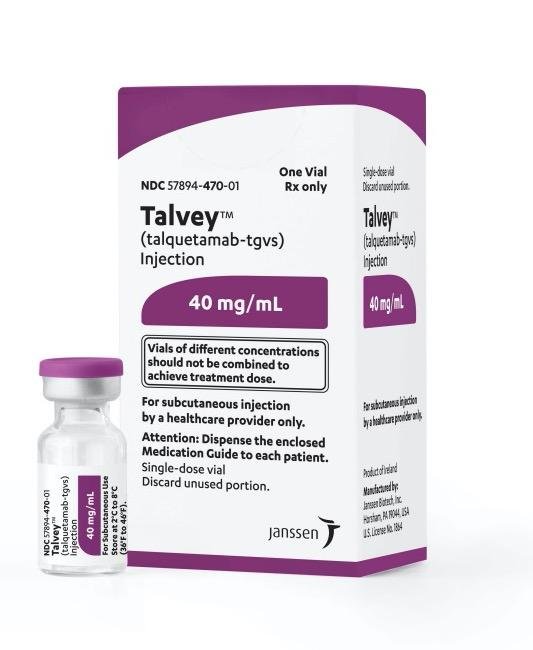
Talquetamab (Talvey) — a bispecific treatment for multiple myeloma
What is talquetamab (Talvey) in simple words
Talquetamab is a treatment for multiple myeloma, used when the disease has already been through several important therapy lines and is still active.
It is not chemotherapy. It is a bispecific antibody: one side attaches to a marker on myeloma cells, and the other side brings T-cells close enough to react. The idea is direct and quite bold — place the immune cell beside the myeloma cell and let the immune system do work it was not doing well on its own.
That does not make it an easy drug. Talvey can be useful, but it needs careful selection, step-up dosing and close observation, especially at the start.
How talquetamab works
Myeloma cells often carry a surface marker called GPRC5D. Talquetamab uses that marker as a point of contact. At the same time, it links to CD3 on T-cells.
This creates a forced meeting between the cancer cell and the immune cell. Sometimes that is enough to restart an immune attack in a disease that has become resistant to usual medicines.
The catch is that immune activation is never perfectly tidy. Fever, inflammation, nerve symptoms, infections and mouth or skin problems are part of the reason this treatment is usually started with a cautious schedule.
What conditions talquetamab is used for
Talvey is mainly discussed in adults with multiple myeloma when the disease has already passed through the standard treatment families. In practice, this usually means:
- myeloma that has come back after earlier control;
- myeloma that keeps moving despite treatment;
- prior exposure to an IMiD-type medicine;
- prior exposure to a proteasome inhibitor;
- prior exposure to an anti-CD38 antibody;
- a situation where another myeloma option is needed.
The diagnosis alone is not enough. Two patients with myeloma can look similar on paper and still need different plans because of marrow reserve, infection history, kidney function, frailty, previous toxicity and speed of relapse.
When talquetamab may be especially relevant
Talquetamab tends to enter the conversation when the usual myeloma routes have narrowed. The patient may have already used the main drug classes, or the disease may have returned too quickly after a previous response.
It can be especially relevant when:
- the myeloma is active after several prior treatments;
- CD38-directed therapy is no longer enough;
- CAR-T is not available or not the next step;
- a bispecific option is being compared with other later-line choices;
- the patient can be monitored during early dosing;
- infection risk is being actively managed.
I would not look at Talvey as just “one more drug”. It changes the rhythm of care. The first doses matter. The support plan matters. The patient’s baseline condition matters just as much as the name of the medicine.
What needs to be checked before starting treatment
Before talquetamab is considered seriously, the oncologist usually wants a clear picture of both the myeloma and the patient. The checklist is practical:
- recent marrow and blood results;
- kidney and liver function;
- calcium level and infection markers;
- current myeloma burden;
- previous treatment history;
- neurological symptoms at baseline;
- mouth, skin and nail condition;
- vaccination and infection history;
- current medicines and steroid use;
- general fitness for repeated visits.
This is where small details matter. A patient with frequent infections, weak counts or active nerve symptoms may still be considered, but the conversation becomes more careful. Talquetamab is not a treatment to start on autopilot.
How treatment is carried out
Talvey is given as an injection under the skin. Treatment does not begin with the full dose immediately. The dose is built up in steps so the team can see how the body reacts before regular dosing continues.
During treatment, doctors usually watch:
- temperature and blood pressure;
- oxygen level and breathing;
- neurological changes;
- blood counts;
- kidney and liver tests;
- signs of infection;
- mouth pain or taste changes;
- skin and nail reactions.
The early period is the most sensitive. Some patients need hospital observation depending on local protocol and individual risk. After that, visits may feel more routine, but monitoring does not stop.
Possible side effects
Talquetamab has a side-effect profile that is different from older myeloma drugs. Some reactions are linked to immune activation. Others are more specific to the target used by this medicine.
Problems that may appear include:
- fever or chills;
- low energy;
- infection;
- low blood counts;
- headache or confusion;
- changes in taste;
- mouth soreness;
- dry skin or rash;
- nail changes;
- muscle or joint pain;
- weight loss or poor appetite.
The mouth and taste issues are easy to underestimate. For some patients they become more than an annoyance because eating changes, weight drops and daily life becomes harder. I ask about this directly, not only about “serious” symptoms.
When to contact a doctor urgently
During treatment, it is better to report symptoms early. Waiting can turn a manageable reaction into a hospital problem.
Contact the treating team promptly if there is:
- fever;
- shaking chills;
- new dizziness;
- shortness of breath;
- confusion or unusual sleepiness;
- trouble speaking;
- new weakness;
- severe diarrhoea;
- painful mouth sores;
- signs of infection;
- sudden decline in how you feel.
Not every symptom means the treatment must stop. But with bispecific therapy, the team needs to know early. That is part of using the drug safely.
Why talquetamab is not right for everyone
A patient can have the “right” diagnosis and still not be a good candidate at that moment. The question is not only whether Talvey can work. It is whether the person can get through the start of treatment safely and whether another option is more sensible.
The decision may change because of:
- active infection;
- very weak blood counts;
- significant frailty;
- unstable kidney function;
- uncontrolled neurological symptoms;
- recent severe treatment toxicity;
- lack of monitoring access;
- another therapy with a better timing fit.
Sometimes the answer is not “no”. It is “not yet”. The patient may need infection control, transfusion support, dental or nutritional help, or a different bridging plan first.
Can talquetamab be combined with other treatments
In routine care, talquetamab is often considered as a later-line myeloma option on its own. Research is looking at combinations, but adding more treatment is not automatically better.
For a patient who has already had years of therapy, the goal is not to make the plan look stronger on paper. The goal is to choose a plan the body can actually tolerate while still giving the myeloma real pressure.
What “no quick response” to treatment means
With myeloma, response is followed through blood tests, sometimes urine tests, imaging and marrow assessment. A patient may feel no dramatic change at first, even when the numbers are beginning to shift.
There are also times when treatment is interrupted or slowed because of fever, infection or other reactions. That does not always mean failure. The important question is whether the disease markers, symptoms and treatment tolerance are moving in a useful direction together.
Oncology consultation for talquetamab (Talvey) in Israel
At Tel Aviv Medical Clinic in Israel, patients can discuss whether talquetamab fits their current myeloma situation and how it compares with other later-line options.
A consultation may be helpful if you need to:
- review prior myeloma treatments;
- understand whether Talvey is realistic now;
- compare bispecific therapy and CAR-T planning;
- discuss infection and monitoring risks;
- prepare questions for the treating haematologist;
- get a second opinion before changing therapy.
We do not replace the treating physician or prescribe remotely. The aim is to make the clinical reasoning clearer before the next decision is made.
Frequently Asked Questions — Dr. Stefanskoy
- Is talquetamab the same kind of treatment as CAR-T therapy?
No. Both approaches use the immune system, but they are not the same. CAR-T treatment involves collecting a patient’s cells, changing them outside the body and then giving them back. Talquetamab is an off-the-shelf antibody treatment. It is given directly, without manufacturing a personalised cell product.
That makes the logistics different. It does not make the treatment simple. Talvey still needs step-up dosing, monitoring and fast reaction if immune side effects appear.
- Why is GPRC5D important?
GPRC5D is one of the markers that can be present on myeloma cells. Talquetamab uses it as a contact point. That is what allows the drug to bring T-cells close to the myeloma cell.
I would not reduce the whole decision to one marker, though. The patient’s treatment history, marrow function, infections and overall condition often decide whether this is the right moment for the drug.
- Can talquetamab work after many previous treatments?
That is exactly the setting where it is usually discussed. Many patients considered for Talvey have already received the main myeloma drug families and need a different type of pressure on the disease.
Still, “many previous treatments” is not one single situation. A patient who is stable between relapses is different from someone whose myeloma is moving quickly and causing organ problems. The timing matters.
- What side effect do patients notice most?
It varies. Fever and early immune reactions get a lot of attention because they can become urgent. But in day-to-day life, mouth soreness, altered taste, dry skin, nail changes and appetite loss can be very frustrating.
These symptoms should not be brushed aside. If a patient stops eating well or loses weight, the treatment becomes harder to continue. Supportive care is part of the plan, not an afterthought.
- Does talquetamab require hospital monitoring?
Often there is close observation around the first doses, and some centres use inpatient monitoring depending on protocol and patient risk. The reason is not that every patient will have a severe reaction. It is because the team wants to catch early immune symptoms before they escalate.
After the early phase, treatment may feel more predictable. Even then, fever, confusion, breathing symptoms or sudden weakness should be reported immediately.
- What if Talvey is not suitable?
Then the discussion should not end. Other myeloma options may still exist: a different bispecific antibody, CAR-T planning, another antibody combination, chemotherapy-based control or a clinical trial.
The right choice depends on what has already been used and why it stopped working. I always want to know the order of previous treatments, not just the list of drug names.
- How do you judge whether treatment is working?
We look at the myeloma markers first, but not only at them. Symptoms, blood counts, kidney function, imaging and how the patient is living through treatment all matter.
A response on paper is not enough if the patient cannot tolerate the process. The best result is disease control that the person can actually continue safely.
Important information
This page is for general medical reference only and does not replace a personal consultation. Talquetamab should only be considered by an oncology or haematology team after reviewing the diagnosis, previous treatment history, current test results and general condition.
Do not start, stop or change treatment without speaking to your treating physician.
To arrange an oncology consultation regarding talquetamab and advanced multiple myeloma treatment options in Israel:
📞 +972-73-374-6844
📧 [email protected]
💬 WhatsApp: +972-52-337-3108