


 Contact Us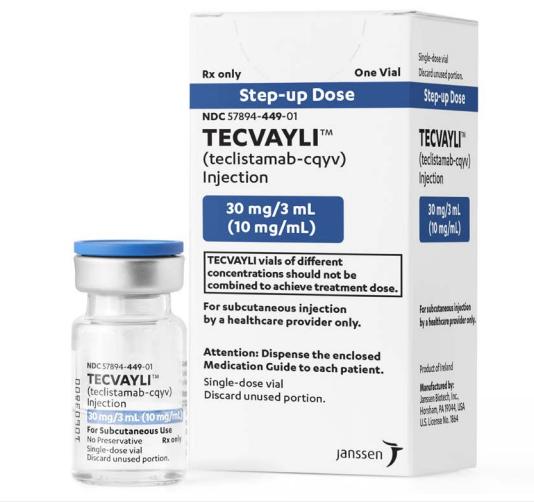
Teclistamab (Tecvayli) — bispecific therapy for multiple myeloma
What is teclistamab (Tecvayli) in simple words
Teclistamab is a treatment for multiple myeloma. It is not a tablet and it is not classic chemotherapy.
The idea is more targeted. The medicine helps bring immune T-cells close to myeloma cells, so the immune system has a better chance of reacting to the disease. That sounds neat on paper. In real life, it needs careful timing, supervision and a patient who is stable enough for the first part of treatment.
It usually enters the discussion after myeloma has already been treated with several other approaches. At that point, the question is rarely “is this drug modern?”. The better question is whether this is the right moment for it.
How teclistamab works
Teclistamab works like a bridge. One side attaches to myeloma cells through BCMA. The other side speaks to T-cells through CD3. When those two are brought into the same space, T-cells may attack the malignant plasma cells more directly.
This is why the treatment can be useful even when earlier myeloma drugs have lost their effect. But the same immune activation can also cause trouble. Fever, confusion, low pressure, infection risk — these are not small details. They shape how the first doses are given and how closely the patient is watched.
So the mechanism is simple to explain, but not simple to manage.
What conditions teclistamab is used for
Teclistamab is mainly discussed in adults with multiple myeloma when the disease has already moved through key treatment families.
- myeloma that has returned after earlier regimens;
- disease that is no longer controlled by standard myeloma medicines;
- previous exposure to an IMiD, a proteasome inhibitor and anti-CD38 therapy;
- a patient who may not be moving straight to CAR-T therapy;
- situations where an off-the-shelf immune treatment is being considered.
The name of the diagnosis is not enough. Two people with myeloma can need very different plans depending on blood counts, kidney function, infection history and how fast the disease is moving.
When teclistamab may be especially relevant
This treatment becomes especially interesting when the old myeloma routine has started to narrow.
- several previous treatment lines;
- short remissions after recent therapy;
- persistent or rising M-protein;
- bone marrow still carrying active disease;
- CAR-T not available, delayed or unsuitable;
- need for a treatment that can start without cell manufacturing.
That last point matters. CAR-T can be powerful, but it takes preparation and time. Teclistamab is different. It is ready as a drug, but the start is still controlled step by step because the immune system can react sharply in the first days.
For some patients, that trade-off is reasonable. For others, infection risk or frailty changes the whole calculation.
What needs to be checked before starting treatment
Before teclistamab is chosen, the oncologist will usually want a very clear picture of the patient, not just the myeloma.
- previous myeloma treatments;
- current blood counts;
- kidney and liver function;
- recent infections;
- immunoglobulin levels;
- neurological history;
- heart and lung reserve;
- current imaging or marrow results;
- support at home after the first doses.
I would not treat this as a simple prescription decision. The early phase asks a lot from the team and the patient. If the person lives far away, has repeated infections or is already very weak, the plan may need adjustment before the first injection is even scheduled.
How treatment is carried out
Teclistamab is given by injection under the skin. Treatment does not begin with the full dose at once. The dose is increased gradually at the start, so the body has a safer introduction to the immune effect.
During this period, monitoring is close. Some patients are observed in hospital, depending on local practice and individual risk. Later, if the early doses are tolerated, treatment usually becomes more routine — but still not casual.
During therapy, the team follows:
- temperature and blood pressure;
- mental clarity and speech;
- blood counts;
- infection signs;
- kidney function;
- myeloma markers;
- general strength and appetite.
Response is judged over time. A single lab result can be encouraging, but it rarely tells the whole story.
Possible side effects
The side effects of teclistamab come from two directions: immune activation and weaker defence against infection. Both need respect.
- fever or chills;
- tiredness;
- headache;
- low blood counts;
- cough or breathing discomfort;
- diarrhoea or nausea;
- injection-site irritation;
- infections;
- confusion, tremor or unusual sleepiness.
The immune reaction at the beginning can look like a bad flu at first. Sometimes it stays mild. Sometimes it needs urgent treatment. The difficult part is that nobody should guess from home which one it is.
Infections deserve the same attention. Myeloma already weakens immunity, and prior treatments may have done the same. Teclistamab can add another layer to that problem.
When to contact a doctor urgently
During treatment, the patient should contact the medical team quickly if something changes in a way that feels unusual.
- fever;
- shaking chills;
- new confusion;
- slurred speech;
- faintness or severe dizziness;
- shortness of breath;
- fast worsening weakness;
- new severe headache;
- signs of infection.
With this type of treatment, early reporting is not overreacting. It is part of safe treatment. Waiting “until tomorrow” can be the wrong instinct.
Why teclistamab is not right for everyone
A drug can be appropriate for the disease and still not be right for the patient at that moment.
Reasons to pause or choose differently may include:
- active infection;
- very low blood counts;
- poor general condition;
- uncontrolled neurological problems;
- recent severe immune reaction;
- limited ability to attend monitoring visits;
- another myeloma option that fits better.
This is where judgement matters. A patient with quickly progressing myeloma may need action, but action without preparation can create avoidable risk. The best plan is the one the patient can actually get through.
Can teclistamab be combined with other treatments
In practice, teclistamab is often considered as its own treatment path. Other medicines may still be used around it — for infection prevention, symptom control, bone protection or supportive care.
Combination treatment is a separate question. It depends on the patient’s earlier therapies, marrow reserve and the reason for adding another drug. More treatment is not automatically better. In myeloma, the body often tells us how much intensity it can tolerate before the disease does.
What “no quick response” to treatment means
Some patients want to know after the first injections whether the treatment is already working. Usually, it is too early.
Myeloma markers can move at different speeds. Symptoms may improve before the numbers look dramatic. Or the numbers may begin to fall while fatigue and infection risk remain the bigger problem. That is why the doctor looks at the whole picture: blood tests, symptoms, marrow information when needed, and how the patient is living week to week.
A slow start does not always mean failure. But if the disease is moving fast, the team cannot wait forever either.
Oncology consultation for teclistamab (Tecvayli) in Israel
At Tel Aviv Medical Clinic in Israel, a consultation can help clarify whether teclistamab fits the current myeloma situation. This is especially useful when several treatments have already been used and the next step is not obvious.
A consultation may help with:
- reviewing previous myeloma therapy;
- understanding whether a bispecific option is reasonable now;
- comparing teclistamab with CAR-T timing;
- checking infection and blood count risks;
- planning questions for the treating haematologist;
- getting a second opinion before changing treatment.
We do not replace the treating doctor. The goal is to make the decision clearer and to help the patient understand what must be checked before moving forward.
Frequently Asked Questions — Dr. Stefanskoy
- Is teclistamab the same as CAR-T therapy?
No. Both use the immune system, but they are not the same treatment. CAR-T is made from a patient’s own cells and takes time to prepare. Teclistamab is already manufactured and can be started without that cell-production process.
That can be useful when time matters or when CAR-T is not available. But it does not mean it is easier. The first doses still need careful supervision because the immune system can react strongly.
- Why is teclistamab usually discussed after several other myeloma treatments?
Because myeloma treatment usually moves through established drug groups first. By the time teclistamab is discussed, the disease has often learned to get around earlier medicines.
I would not look only at the number of previous lines. I want to know how long each treatment worked, how the marrow is behaving, whether the kidneys are stable and whether infections have been a problem. Those details change the decision.
- What makes the first doses different from later treatment?
The beginning is the most sensitive part. The immune system is meeting the drug and may respond with fever, pressure changes or neurological symptoms. That is why the dose is introduced gradually and the patient is watched more closely.
If those first steps go smoothly, later treatment often becomes more predictable. Still, I do not call it simple. Infections and blood count problems can appear later too.
- Can an older patient receive teclistamab?
Age alone is not the deciding factor. I have seen older patients who are stronger than much younger ones. What matters is fitness, infections, kidney function, support at home and how quickly the myeloma is progressing.
For a frail patient, the question becomes practical: can we monitor safely, prevent complications and react fast if something changes? If the answer is no, the plan needs to be adjusted.
- What is the main risk patients should understand?
There are two main risks I explain carefully. The first is an early immune reaction, which can start with fever and sometimes become serious. The second is infection, because patients with advanced myeloma often have weak immune defence already.
This is why I do not like vague instructions such as “call if you feel unwell”. Patients need to know exactly which symptoms matter and whom to call, including after hours.
- How soon can we know whether it is working?
Not from the first injection. The team usually follows blood markers over several weeks and compares them with symptoms and general condition.
If the numbers begin to fall and the patient is holding steady, that is encouraging. If markers rise quickly or the patient becomes weaker, we reassess. Myeloma decisions should not be made from one isolated test.
- What if teclistamab is not suitable?
Then we look at the whole treatment map again. Depending on what has already been used, options may include another bispecific antibody, CAR-T therapy, a clinical trial, chemotherapy-based treatment or a more supportive plan.
The aim is not to force one drug into the plan. The aim is to choose the next step that fits the biology of the myeloma and the reality of the patient.
Important information
This page is for general medical information only. It is not a treatment recommendation and cannot replace consultation with a haematologist or oncologist.
Teclistamab should be considered only after reviewing the diagnosis, previous treatment history, current test results, infection risk and the patient’s overall condition.
Do not start, stop or change treatment without your treating physician.
To arrange an oncology consultation regarding teclistamab and advanced myeloma treatment in Israel:
📞 +972-73-374-6844
📧 [email protected]
💬 WhatsApp: +972-52-337-3108