


 Contact Us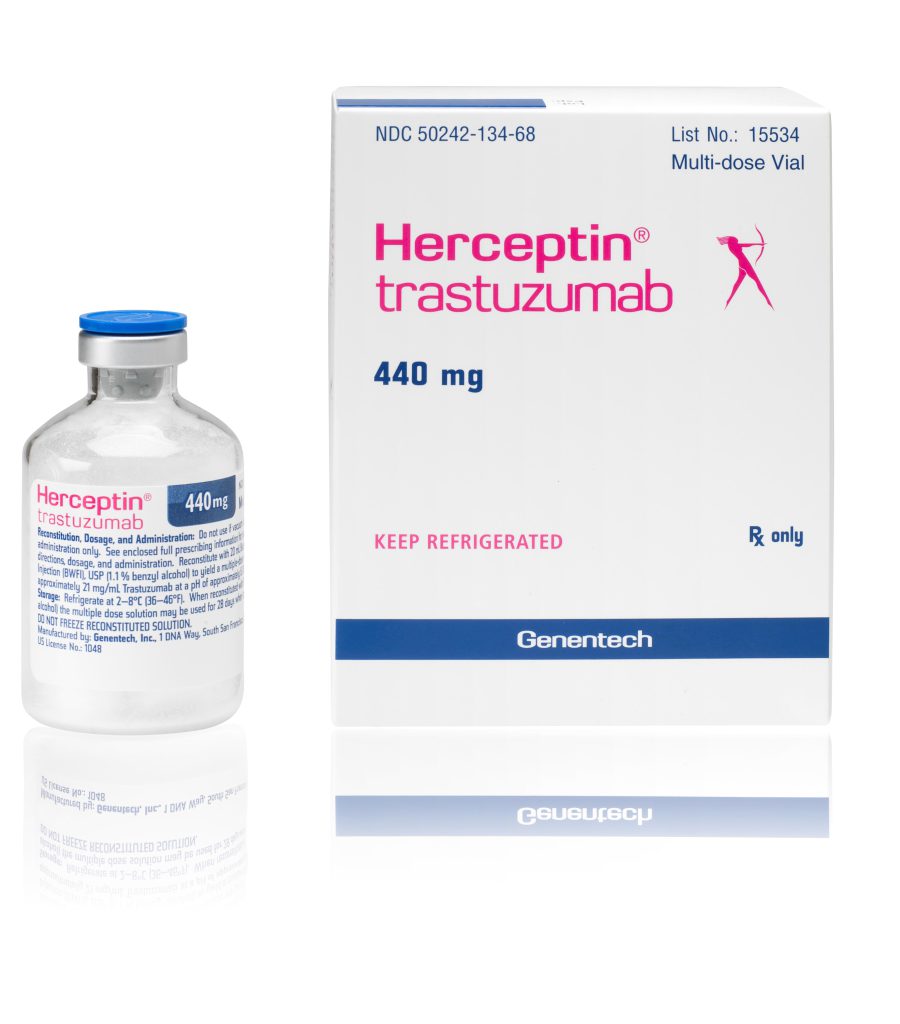
Trastuzumab (Herceptin) — targeted treatment for HER2-positive cancer
What is trastuzumab (Herceptin) in simple words
Trastuzumab (Herceptin) — a targeted drug for cancers that carry too much of a specific growth protein on their surface.
Some tumours have an abnormally high level of a growth receptor — a protein that drives the cancer to divide faster and more aggressively than normal. Trastuzumab attaches to that receptor and blocks it. The growth signal is disrupted. The cancer loses one of its key drivers.
This is not chemotherapy. It does not attack all rapidly dividing cells. It targets a specific molecular feature of the tumour. That is what makes it a targeted treatment — and also why testing for that feature before starting is not optional.
When that growth receptor is present in sufficient quantity, trastuzumab can change the clinical picture substantially. When it is not — the drug has no meaningful target and no meaningful effect.
How trastuzumab works
The growth receptor it targets — called HER2 — sits on the surface of tumour cells. In cancers where this receptor is overexpressed, it sends continuous signals telling the cell to grow and divide. Trastuzumab binds to HER2 and blocks those signals.
It also works through a second mechanism. By attaching to the tumour cell surface, it flags those cells for destruction by the immune system — specifically by immune cells that recognise and eliminate cells marked as abnormal.
Two mechanisms acting simultaneously. How much each contributes in practice is still studied, but both are part of why trastuzumab works in cancers where HER2 is genuinely overexpressed.
What conditions trastuzumab is used for
Trastuzumab is used in cancers where the HER2 growth receptor is overexpressed:
- breast cancer — early stage and advanced;
- stomach and gastro-oesophageal junction cancer;
- other cancers with confirmed overexpression of this growth receptor, in selected settings.
In breast cancer, trastuzumab fundamentally changed outcomes in the subset of patients whose tumours carry high levels of this receptor — roughly one in five cases. Before this drug, that subtype was associated with more aggressive behaviour and worse prognosis. Adding trastuzumab to treatment reduced the risk of the cancer returning after surgery by roughly half in early-stage disease. That is not a marginal effect.
In stomach cancer, testing for this receptor is now standard before first-line treatment. When it is found at high levels, adding trastuzumab to chemotherapy improved survival in clinical data. The treatment approach in this cancer changed because of that finding.
When trastuzumab may be especially relevant
It comes into discussion when:
- breast cancer has tested positive for overexpression of the HER2 receptor — before surgery, after surgery, or in advanced disease;
- stomach or gastro-oesophageal junction cancer shows high receptor expression on testing;
- early breast cancer where reducing recurrence risk after surgery is the goal;
- advanced breast cancer that has not previously received this type of targeted treatment;
- situations where a less toxic alternative to chemotherapy-only approaches is being considered.
Early breast cancer and advanced breast cancer are genuinely different situations with different goals. In early disease, trastuzumab is given to reduce the chance of the cancer coming back — not because there is measurable disease to shrink. In advanced disease, the goal shifts to controlling progression for as long as possible. I always clarify which situation applies, because the expectations and the monitoring approach differ considerably.
What needs to be checked before starting treatment
Before trastuzumab is considered, the oncologist will typically want to assess:
- HER2 receptor status — confirmed by tissue testing with two methods if the first is intermediate;
- cancer type and stage;
- heart function — an echocardiogram or equivalent before starting;
- prior treatment history;
- hormone receptor status in breast cancer — relevant for the overall treatment plan;
- kidney and liver function;
- performance status.
Heart function is the one I pay closest attention to before starting trastuzumab. The drug can reduce the heart’s pumping efficiency over time — usually reversibly when caught early, but it needs monitoring. An echocardiogram at baseline is not a formality. It is the starting point for a monitoring schedule that runs throughout treatment. Patients with pre-existing heart disease or those who have previously received certain chemotherapy drugs need particularly careful assessment before starting.
The HER2 testing method also matters. A result of 2+ on the first test requires a second confirmatory test using a different technique. A result of 3+ on the first test is sufficient. These are not interchangeable thresholds, and using trastuzumab based on an inadequately confirmed result is a clinical error worth preventing.
How treatment is carried out
Trastuzumab is given intravenously — usually every three weeks, though some protocols use a weekly schedule. A subcutaneous formulation also exists that can be administered by injection rather than infusion — significantly faster and more convenient for patients on long courses.
In early breast cancer, the standard course lasts one year. In advanced disease, treatment continues as long as it is working and the patient can tolerate it.
Monitoring during treatment:
- heart function assessed every three months — echocardiogram;
- blood count and chemistry at regular intervals;
- imaging to track response in advanced disease;
- monitoring for infusion-related reactions — more common with the first infusion.
The three-monthly cardiac monitoring is the part patients sometimes find burdensome — particularly in early disease where they feel well and the cancer is no longer visible. I explain why it matters. A significant drop in heart function that is caught early can be managed. If it is missed and continues, recovery becomes less certain.
Possible side effects
Side effects that may appear:
- reduced heart pumping function — the most specific risk with this drug;
- infusion reactions — chills, fever, shortness of breath, usually with the first infusion;
- fatigue;
- nausea;
- diarrhoea;
- joint and muscle pain;
- headache;
- increased susceptibility to infections.
Cardiac toxicity is what makes trastuzumab different from most targeted drugs. The drop in heart function is usually reversible — trastuzumab does not cause the same type of permanent damage that certain chemotherapy agents can. But reversible does not mean unimportant. If a patient develops symptoms — breathlessness with minimal exertion, ankle swelling, a feeling of the heart beating harder than usual — that needs prompt assessment. Not monitoring at home.
When to contact a doctor urgently
Contact your doctor without delay if any of the following develop:
- breathlessness at rest or with minimal activity;
- swelling of the ankles or legs;
- feeling of the heart racing or beating irregularly;
- chest pain or pressure;
- chills, fever or difficulty breathing during an infusion;
- sudden significant increase in fatigue;
- sudden significant deterioration in general wellbeing.
Breathlessness and ankle swelling together during trastuzumab treatment are cardiac symptoms until proven otherwise. Same-day assessment. Not watchful waiting.
Why trastuzumab is not right for everyone
What affects whether this is appropriate:
- HER2 receptor not overexpressed — no target, no benefit;
- borderline HER2 result not confirmed with a second test — confirmation required before treatment;
- significantly reduced heart function at baseline;
- prior cardiac damage from other treatments;
- active or poorly controlled heart failure.
In breast cancer, a new category has emerged — tumours with low but detectable levels of this receptor that do not meet the threshold for trastuzumab but may qualify for a different drug in the same class. This is an area where the testing interpretation has become more important than it was a few years ago. A result that previously meant “not eligible” may now open a different treatment pathway — depending on what is being considered and why.
Can trastuzumab be combined with other treatments
Yes — and combination is standard in most settings. In early breast cancer it runs alongside chemotherapy and sometimes alongside a second targeted drug in the same class. In advanced breast cancer the combinations vary depending on prior treatment and the overall treatment plan. In stomach cancer it is added to chemotherapy as first-line treatment.
Combining trastuzumab with certain chemotherapy drugs that carry their own cardiac risks requires more careful monitoring. The cardiac effect is additive. I factor prior chemotherapy history into the baseline assessment every time.
What ‘no quick response’ means
In early breast cancer, there is no tumour to measure — trastuzumab is reducing recurrence risk, not shrinking visible disease. Response in this setting is measured in years, not scans. That requires a different mindset from the patient. I explain this clearly before starting.
In advanced breast cancer, response is tracked through imaging. Targeted drugs sometimes produce slower visible changes than chemotherapy. Stability on early scans can be a positive result. I look at the trend over multiple assessments rather than drawing conclusions from a single time point.
Oncology consultation for trastuzumab (Herceptin) in Israel
At Tel Aviv Medical Clinic in Israel, consultations are available on trastuzumab and targeted treatment for cancers where the HER2 growth receptor is overexpressed. Oncologists at the clinic follow ESMO and NCCN guidelines and have experience across both breast cancer and stomach cancer settings — including early-stage adjuvant treatment, advanced disease management, and situations where HER2 testing results are borderline or disputed.
In Tel Aviv Medical Clinic, you can discuss:
- whether HER2 testing has been done correctly and interpreted appropriately;
- trastuzumab as part of an early breast cancer treatment plan;
- treatment options in advanced breast cancer or stomach cancer with this receptor;
- cardiac monitoring requirements and what to watch for;
- second opinion on a proposed treatment plan;
- treatment options in Israel and internationally.
Sometimes patients come not to start a new treatment, but to understand whether the HER2 result they received actually means what they were told it means. That is a legitimate question — and one worth answering carefully.
Frequently Asked Questions — Dr. Stefanskoy
- What does it mean when a cancer tests positive for this growth receptor?
It means the tumour cells carry an abnormally high number of a specific protein on their surface — one that drives growth signals. Cancers with this feature tend to grow faster than those without it. That sounds alarming. The other side of it: these cancers respond specifically to drugs like trastuzumab in a way that others do not.
Testing positive used to mean a harder prognosis. With targeted treatment now available, that has changed substantially. In early breast cancer, adding trastuzumab to treatment roughly halved the recurrence rate in clinical data. That kind of effect on a disease course is meaningful.
- Why does heart function need to be monitored so carefully?
Trastuzumab can reduce the heart’s pumping efficiency over time. The mechanism is different from the damage caused by certain chemotherapy agents — it does not destroy heart muscle in the same way, and the effect is usually reversible when caught early. But it needs to be caught.
The three-monthly echocardiogram schedule is not precautionary bureaucracy. If pumping function drops below a certain threshold, trastuzumab is held until it recovers. In most cases it does. In patients where it does not recover adequately, continuing treatment carries too much risk. Catching the drop early gives the best chance of recovery and continuing.
- What is the difference between the intravenous and subcutaneous formulations?
The drug is the same. The delivery method differs. The intravenous formulation is given as an infusion over 30 to 90 minutes. The subcutaneous version is injected under the skin and takes around five minutes.
For patients on a year-long course in early breast cancer, that time difference adds up. A five-minute injection versus a 90-minute infusion repeated every three weeks over twelve months is a significant practical difference. The subcutaneous option is not available everywhere, but where it is, I always discuss it. Quality of life during treatment matters.
- Can trastuzumab be used in stomach cancer?
Yes — when the growth receptor is overexpressed. Testing for this receptor is now standard before starting first-line treatment in stomach and gastro-oesophageal junction cancer. When the result is positive at a high level, adding trastuzumab to chemotherapy has shown improved survival outcomes.
The testing threshold that determines eligibility is different in stomach cancer from breast cancer. A result that would be borderline in one cancer type may be clearly positive in the other. I always check that the result is being interpreted according to the appropriate criteria for the specific cancer.
- What happens if trastuzumab stops working in advanced disease?
There are further options. The same drug class has expanded significantly — newer drugs targeting the same receptor, or using it as a delivery mechanism for a chemotherapy payload, have shown activity after trastuzumab has stopped working. The sequence of these options depends on what has already been used and what the current disease status looks like.
Re-testing the tumour’s receptor status at the time of progression is sometimes warranted. Tumours can change, and a biopsy at relapse may show different characteristics from the original diagnosis. I factor that into the discussion about next steps.
- Is trastuzumab continued indefinitely in early breast cancer?
No. In early breast cancer, the standard course is one year — typically given alongside and then following chemotherapy. After that, trastuzumab stops.
Whether to continue beyond one year has been studied. The data does not clearly support it — and the cardiac monitoring burden and potential cumulative cardiac effects make extending beyond the standard course difficult to justify unless there is a specific clinical reason. One year is the established, evidence-supported course.
- Are there alternatives if trastuzumab is not tolerated?
Yes. Other drugs in the same class target the same receptor through different mechanisms or with different formulations. Some have different cardiac profiles. The choice of alternative depends on the cancer type, the stage, what has already been tried and what the specific tolerability issue is.
In early breast cancer, certain treatment adaptations are possible — including reducing or stopping trastuzumab if cardiac function is significantly affected. What that means for overall treatment depends on the individual situation and requires a careful clinical discussion.
Important information
Trastuzumab (Herceptin) is considered only after confirmed testing of the growth receptor status, cardiac function assessment, cancer staging and overall patient condition.
Do not start, stop or change treatment without consulting your treating physician.
For a consultation in Israel:
📞 +972-73-374-6844
📧 [email protected]
💬 WhatsApp: +972-52-337-3108